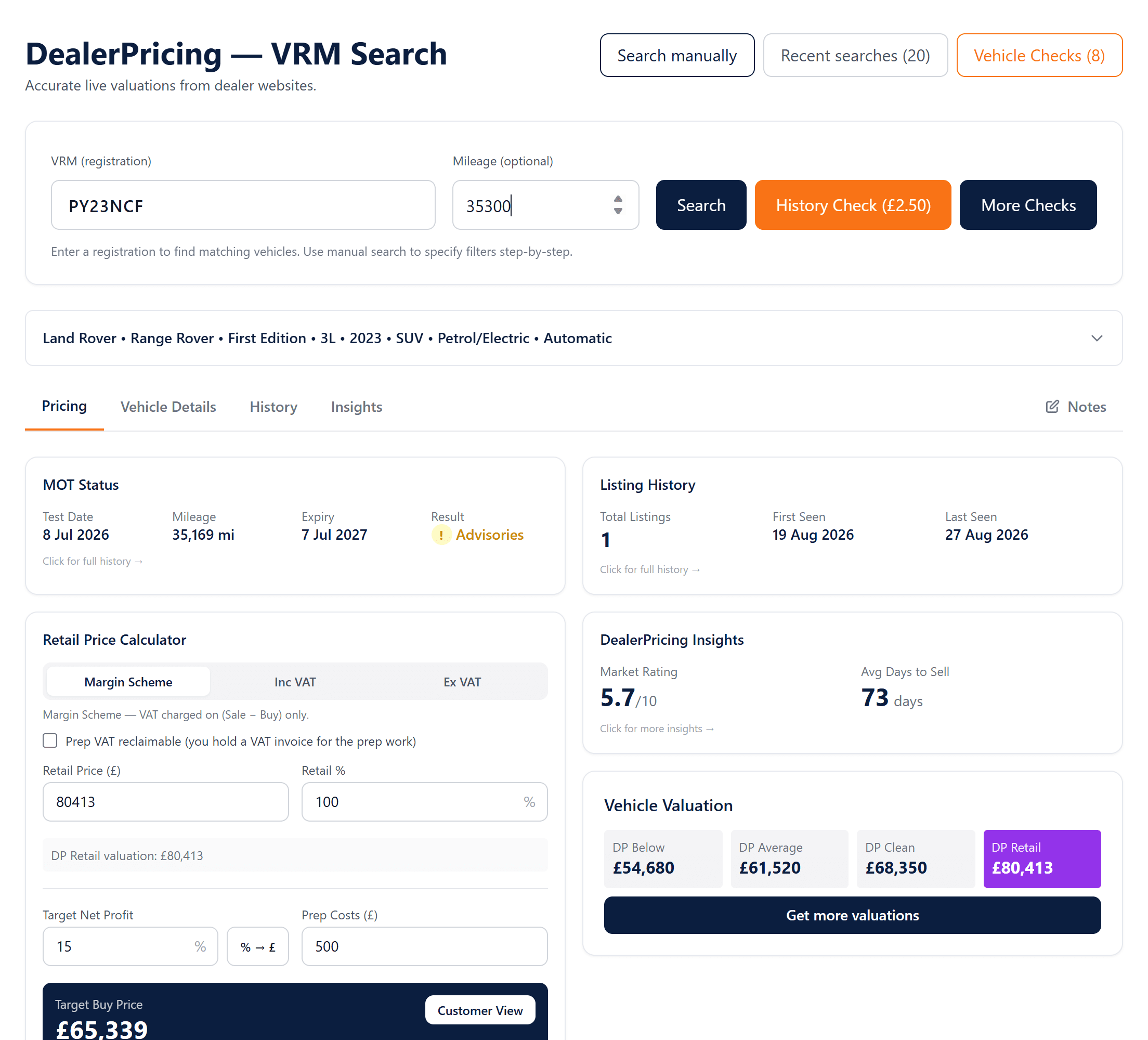
How DealerPricing works: live market pricing for UK dealers
DealerPricing turns a registration number into live trade and retail values, comparable stock, history checks and days-to-sell data for UK car dealers.
DealerPricing is a pricing platform built by car dealers for UK motor traders. Type in a registration and mileage and it returns trade and retail valuations, every comparable car currently for sale and recently sold, days-to-sell data, MOT history and a £2.50 vehicle history check, all from live market data refreshed every hour rather than a monthly guide book.
Key takeaways
- DealerPricing values a car from live listings, not a printed guide, so the figures move with the market.
- One search returns trade bands, retail benchmarks, comparable stock, sold prices and days to sell.
- Vehicle history checks cost £2.50 for subscribers and £3.99 for one-off users.
- Plans start at £70 a month for 100 searches, with 50% off the first month and no annual contract.
- Free MOT and DVLA checks need no account at all.
What is DealerPricing?
DealerPricing is a web-based pricing and vehicle-check platform for the UK motor trade. It was established by car dealers who were tired of paying for monthly guide books that lagged the market and consumer marketplaces that were never designed for buying stock. The platform pulls together live used car listings from more than 11,000 UK dealers, recently sold prices, DVLA and DVSA records and the national provenance databases, and presents them on a single dashboard.
The audience is independent dealers, franchised used car departments, car supermarkets, traders buying at auction and anyone else who has to put a number on a used car quickly and defend it. Private buyers can also use the free vehicle check and the one-off history check without a subscription.
How does a DealerPricing search work?
Every search starts with a registration number. The platform decodes the exact vehicle, including make, model, variant, engine, gearbox, fuel type, body style and doors, then finds the cars that genuinely match it in the live market. A search takes a few seconds and returns four things.
First, a trade valuation with Trade Poor, Trade Average and Trade Clean bands, a suggested retail position, a forecourt retail figure and a part-exchange figure. Second, a table of comparable cars for sale right now with price, mileage, days listed, dealer and distance from your postcode. Third, the prices similar cars actually sold for in the last 90 days. Fourth, market insights that show how many similar cars are for sale, how many sold recently and how long they take to clear.
If the car has no registration yet, or the plate is private, the manual search wizard steps through make, model, year, fuel, transmission, body type, drivetrain, engine size and trim to reach the same result. The dashboard guides walk through each screen.
Where does the data come from?
DealerPricing does not rely on a single opinion of value. It reads live listings from dealer websites across the UK, over 680,000 active vehicles at any time, and refreshes them hourly, so a price cut made this morning is in the comparables this afternoon. Sold prices come from listings that disappeared from the market in the last 90 days, which is the closest available signal to what a car actually achieved rather than what someone asked.
Vehicle identity, tax status and MOT history come from the DVLA and DVSA. Provenance markers such as stolen, finance and write-off records come from the Police National Computer, the insurers' MIAFTR register, finance company registers and the DVLA, the same national databases that branded history checks use.
What does a trade valuation on DealerPricing include?
The valuation card shows a bid range by condition rather than a single figure. Trade Poor, Trade Average and Trade Clean tell you what to pay for a tired, average or clean example of that exact car and mileage. DP Retail and the forecourt Retail figure show what the same car sells for, so the gap between them is your gross margin before preparation. The Part Exchange figure is the number to put in front of a customer. A confidence range shows how tight the underlying data is, which matters on unusual derivatives where a handful of listings can swing the average.
Below the card, the Retail Price Calculator takes the retail figure, your target net profit, prep costs and VAT treatment (margin scheme, VAT inclusive or VAT exclusive) and gives you the maximum buying price for the deal you want. The trade valuation guide shows the full workflow.
What vehicle checks are built in?
Every search shows the current tax status, MOT expiry, the mileage recorded at each MOT test plotted as a chart, and every advisory and failure in the tester's own words. Those come from public DVSA and DVLA data and are free.
The vehicle history check goes further. For £2.50 from a subscriber's balance, or £3.99 for a one-off user, it searches for stolen markers on both the PNC and MIAFTR, outstanding finance with the lender and agreement details, insurance write-off category A, B, S or N, recall, import, export and scrappage markers, plate and colour changes and mileage consistency across every MOT reading. The report opens with Vehicle clear or Issues found, downloads as a PDF and stays in your account for six months. Pro subscribers can also run a service history check that compares a seller's full service history claim against the manufacturer's digital records.
How do dealers use the market insights?
The Insights tab answers the question a valuation cannot: will this car sell? It shows active supply (how many comparable cars are for sale), how many sold in the last 90 days, the average days to sell, demand, competition and turnover ratings, and the share of similar cars that cleared within 30, 60 or 90 days. A Ford Puma with 40 comparables and a 27-day average is a different buying decision from an estate with 200 comparables sitting for 80 days, even if the trade values are similar.
Dealers use the same screen on their own stock. Sorting the comparable table by days listed shows which of your cars are overpriced relative to the market before the age report does. The insights guide explains each rating.
What does DealerPricing cost?
Subscriptions are priced by monthly search allowance. Basic 100 is £70 a month for 100 searches and Pro 100 is £99 a month for 100 searches plus service history checks, additional valuations and spec sheets. Basic 200 and Pro 200 double the allowance at £135 and £195. Every plan gets 50% off the first month, there is no setup fee and no annual contract. History checks are £2.50 each from the account balance on any plan.
Private buyers and occasional traders do not need a subscription. The free vehicle check returns MOT history, tax status and DVLA details for any UK registration with no account, and a full history check is £3.99 as a one-off. Developers and dealer management system providers can access the same data through the DealerPricing API.
Who is DealerPricing for?
Independent dealers use it to bid at auction and price part-exchanges in under a minute. Franchised used car managers use it to benchmark forecourt prices against every competitor within a chosen radius. Traders and remarketing teams use the sold data and days-to-sell figures to avoid stock that will not turn. Private buyers use the free and one-off checks to avoid buying a car with finance owing or a hidden write-off. The common thread is a live, auditable number rather than an estimate from a book printed last month.
Frequently asked questions
Is DealerPricing a replacement for CAP or Glass's guide books?
For most day-to-day pricing, yes. Guide books publish monthly values derived from past trade data, while DealerPricing values a car from the cars for sale and recently sold this week. Some dealers keep a guide subscription for finance settlements or lender requirements, but use DealerPricing for buying, part-exchange and retail pricing because the numbers reflect today's market.
Do I need a subscription to use DealerPricing?
No. The free vehicle check and the £3.99 one-off history check work without an account. A subscription is only needed for the dealer dashboard, which adds trade and retail valuations, comparable stock, sold prices, market insights and £2.50 history checks. Plans start at £70 a month with 50% off the first month and no contract.
How accurate are DealerPricing valuations?
The valuation is built from the comparable cars listed and sold in the live market for that exact specification and mileage, and every comparable is shown so you can audit it. The confidence range tells you how tight the data is. On mainstream cars with plenty of comparables the range is narrow; on rare derivatives it widens, and the listings table lets you judge for yourself.
Can DealerPricing check a car's history as well as its value?
Yes. The same dashboard runs a full vehicle history check for £2.50, covering stolen, finance, write-off, mileage, plate and colour changes and import, export and scrappage markers, with a PDF report. Free MOT history and tax status are included with every search.