Digital service records: when each UK car brand went digital
The year each UK car brand replaced the stamped service book with a digital record, what it is called, who can see it and how to check one by registration.
The stamped service book is disappearing from UK glove boxes. Since Mazda went paperless in 2005, every major manufacturer has moved its servicing record into a central digital system that only its dealers, and usually the registered keeper, can see. This guide lists the year each brand switched, what it calls its record, who can read it, and how a buyer checks it by registration for £4.99.
Key takeaways
- Mazda (2005) and Mercedes-Benz (2007 to 2008) went digital first; most other brands switched between 2012 and 2014, and Ford last, in 2022.
- Each group names its record differently: Digital Service Schedule (Volkswagen Group), Digital Service Booklet (Mercedes-Benz and smart), Digital Service Record (Mazda and Ford), Online Service History (Jaguar Land Rover).
- Owners can usually see their own record free in the manufacturer's app; buyers cannot, which is why a check by registration exists.
- For most brands only franchised dealers write to the record. The Volkswagen Group and Mercedes-Benz are the exceptions: licensed or registered independent garages can write to the same record.
- A car with no service history is typically valued 10 to 20 per cent below the same car with a full record, so verifying the claim before you pay is worth £4.99.
What is a digital service record?
A digital service record is the manufacturer's own electronic log of a vehicle's servicing. When a franchised dealer services the car, its workshop system writes the date, mileage, the type of service and the work carried out against the vehicle's chassis number in the manufacturer's central database. There is no stamp, no book and nothing kept in the car. The record travels with the vehicle from owner to owner, and a dealer anywhere in the network can call it up from the VIN or, through a service history check, from the registration.
The practical consequence is that a digital entry cannot be back-dated or stamped up the way a paper book can. That makes it the strongest evidence a seller can offer for a "full service history" claim, and the quickest way to catch one that is not true. It also means the record is only as complete as the dealer network's involvement: work done by an independent garage appears only if that garage has the manufacturer's licence to upload it, which for most brands it does not.
When did each manufacturer go digital?
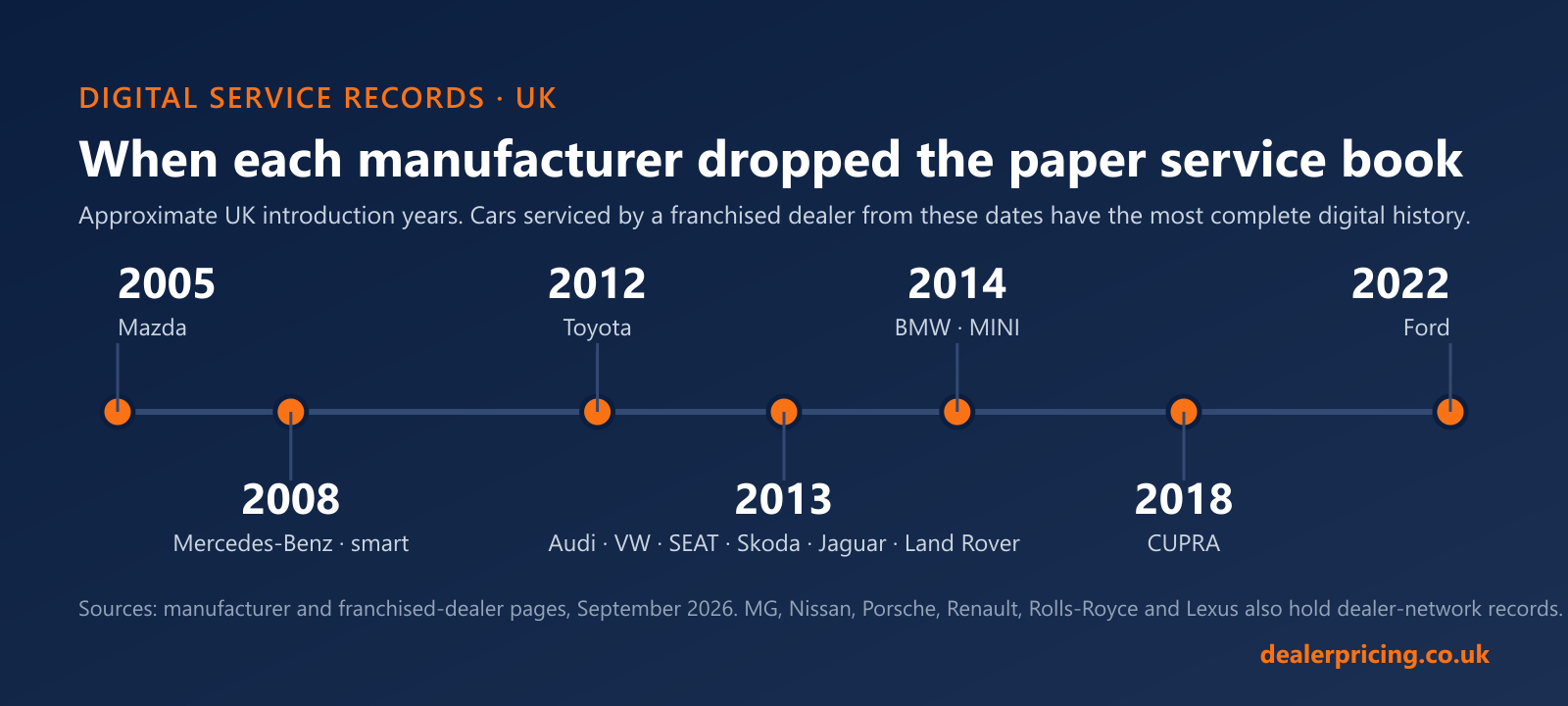
The dates below are approximate UK introduction years, drawn from manufacturer and franchised-dealer pages. Several brands ran paper and digital side by side for a few years, so a car built just after the switch may still have its earliest services in the book only.
| Brand | Record name | Digital since | Who can see it |
|---|---|---|---|
| Mazda | Digital Service Record (DSR) | 2005 | Owner in the MyMazda app; dealers |
| Mercedes-Benz, smart | Digital Service Booklet (DSB) | 2007 to 2008 (vans 2012) | Owner on the Mercedes me website; dealers and independents registered on the B2B Connect portal |
| Toyota | Online service history (MyToyota) | December 2012 | Owner via free portal registration; dealers. Paper booklet still issued alongside |
| Audi, Volkswagen, SEAT, Skoda | Digital Service Schedule (DSS) | around 2013 | Owner in the brand app after dealer verification; dealers and ODIS-licensed independents |
| Jaguar, Land Rover | Online Service History (OSH) | July 2013 | Owner by request with VIN and proof of ownership; dealers |
| BMW, MINI | Digital service history | around 2014 | Owner in the My BMW app or in the car's iDrive menu; dealers |
| Lexus | Online service history (My Lexus) | not confirmed | Owner via free portal registration; dealers |
| CUPRA | Digital Service Schedule (DSS) | 2018 (brand launch) | Owner in the MyCupra app; dealers and licensed independents |
| Ford | Digital Service Record (DSR) | 2022 | Owner in the FordPass app; dealers |
| MG, Nissan, Porsche, Renault, Rolls-Royce | Dealer-network record | varies | Mainly dealers; owner apps show little or only recent history |
Two of those rows deserve a note. Porsche's My Porsche app only began showing maintenance history for work done from April 2025, so for most used Porsches the dealer network's own record and the paper book are still the history. Renault shows owners only the services carried out during their own ownership, so a private seller genuinely may not be able to see what the previous keeper did. Each brand has its own page on DealerPricing, for example BMW service history, Audi service history and Mercedes-Benz service history, with the interval and reading rules for that make.
Who can see the record, and who cannot
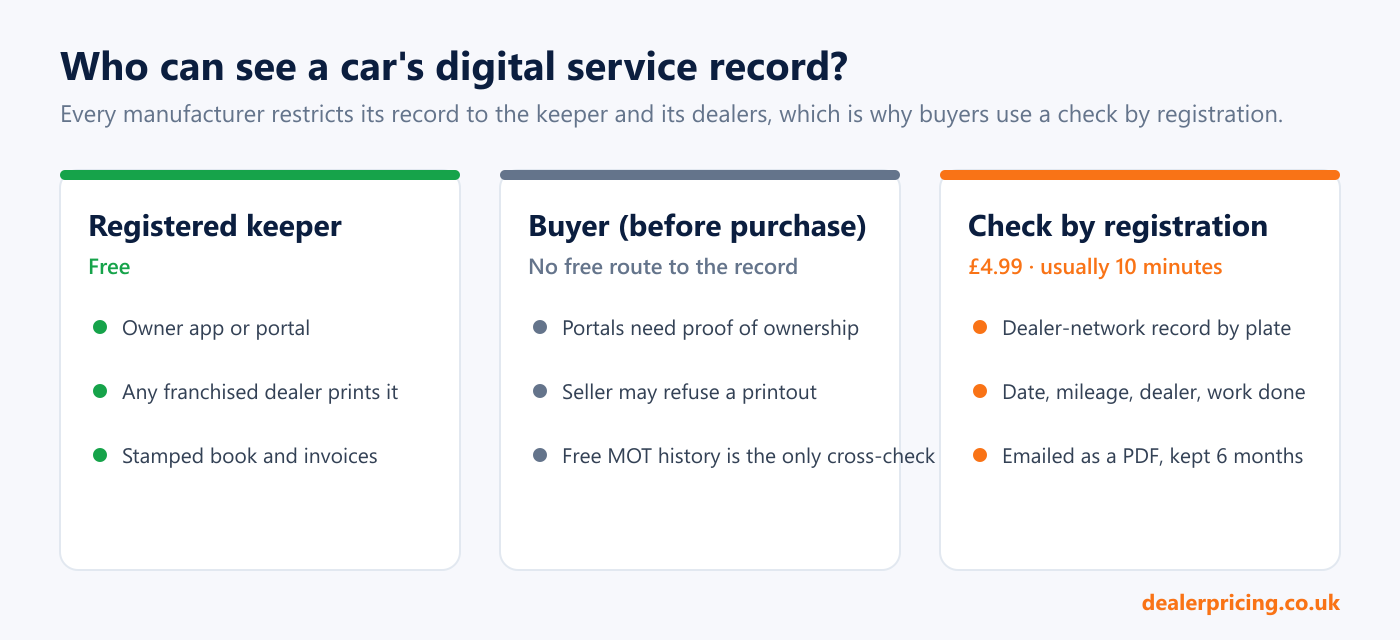
If you are the registered keeper, the record is usually free to see. Every group now offers an app or owner portal, and any franchised dealer will print the record for the keeper. Some brands make it harder than others: Audi requires the dealer to verify the owner in person with the V5C and photo ID before the app shows the record, Jaguar Land Rover asks for the VIN and proof of ownership, and Mercedes-Benz shows the full booklet on its website rather than in the app.
If you are buying the car, none of those routes are open to you, because every manufacturer restricts its record to the keeper and its dealers. You can ask the seller for a printout, and a reluctant seller is telling you something, but you cannot look it up yourself. That gap is what a check by registration fills: the request goes to the manufacturer's dealer network and returns the entries it holds, without the VIN, the log book or the seller's permission. The free routes and when the paid check is worth it are set out in a separate guide.
Why the record matters for the price
Service history is one of the largest single influences on a used car's value after age and mileage. A car with a full service history typically sells for 5 to 10 per cent more than the same car with none, and a car with no history at all is commonly valued 10 to 20 per cent lower and takes longer to sell, because many buyers will not consider it at any price. Premium brands are penalised hardest: buyers of a used BMW, Audi or Mercedes-Benz expect a full dealer record and price the car as if it were neglected when there is none.
Dealers use the record in the same way from the other side of the desk. Before bidding at auction, a digital check separates a genuine full-history car from a stamped book of unknown provenance. At the part-exchange desk, showing the customer the manufacturer's own entries makes a lower offer easy to justify. The dealer guide to service history covers that workflow; for buyers, the no service history guide explains when a missing record is acceptable and when it is a red flag.
How to check a digital service record by registration
Enter the registration on the DealerPricing service history check. The make is confirmed from DVSA and DVLA records first, so a car from a brand that is not covered is stopped before anything is charged. Add an email address, pay £4.99, and the request is sent to the manufacturer's dealer network. Most results arrive within ten minutes; a few manufacturers take up to 48 hours. The page updates itself and the records are emailed as a PDF, with the manufacturer's own document attached where one is supplied. Twenty makes are covered: Audi, BMW, Cupra, Ford, Jaguar, Land Rover, Lexus, Mazda, Mercedes-Benz, MG, MINI, Nissan, Porsche, Renault, Rolls-Royce, SEAT, Skoda, Smart, Toyota and Volkswagen. The check is included for DealerPricing trade subscribers on the dashboard.
Read the result against the manufacturer's interval. Mileages should rise steadily and match the mileages recorded at each MOT, which are free to check on the free MOT history check. Entries further apart than the interval mean a service was missed, done late, or done by an independent garage that could not upload it, and invoices should cover the gap. Nothing before the brand's digital start year is normal; nothing at all on a car advertised with "full main dealer history" is not.
What "no records found" means
A search that returns no entries is not proof the car was never serviced. It means the manufacturer's system holds nothing against the vehicle, which happens when the car was serviced by independent garages that do not write to the record, when its services were stamped in a paper book before the brand went digital, or, occasionally, when a dealer failed to log the work. It is also what you will see when a seller's claim of dealer history is simply untrue. Because the search is carried out in full either way, the £4.99 fee applies whether or not records are found, and a clear "no records held" result is itself useful evidence when negotiating.
Frequently asked questions
Is a digital service record the same as full service history?
No. A digital record is where the evidence lives; full service history is a judgement that every scheduled service was done on time. A digital record with every interval present is the strongest possible full service history. A digital record with gaps is partial history, however many stamps the paper book has.
Can I check a car's service history for free?
As the registered keeper, usually yes, through the manufacturer's app or portal or a dealer printout. As a buyer, no: every brand restricts the record to the keeper and its dealers, so the only way to see it yourself is a check by registration. MOT history, which includes every recorded mileage, is free and is the best free cross-check on any service claim.
Will servicing by an independent garage show in the record?
For Audi, Volkswagen, SEAT, Skoda and CUPRA, often yes, because independent garages that hold the Volkswagen Group's diagnostic licence write to the same Digital Service Schedule as a dealer. Mercedes-Benz and smart go further: any independent registered on Mercedes-Benz's free B2B Connect portal can record a service in the Digital Service Booklet. For most other brands only the franchised network writes to the record, so independent servicing appears only on the garage's invoices.
Which year should a car be to have a digital service record?
It depends on the brand. Mazda records go back to 2005 and Mercedes-Benz to 2008, Toyota's online history to late 2012, Volkswagen Group and Jaguar Land Rover records to around 2013, BMW and MINI to around 2014, and Ford only to 2022. As a rule, cars from 2012 onwards that have been serviced by a franchised dealer give the most complete results.
How long does a service history check take?
Usually under ten minutes, because the request is answered live by the manufacturer's dealer network rather than from a stored copy. Some manufacturers queue requests and reply within 48 hours; the result is emailed when it arrives, so there is no need to wait on the page.