Pricing & valuations for dealers
Free part-exchange appraisal form (PDF) and PX offer calculator
Download the free appraisal form and walk round the car with it, pricing every fault: tyres, brakes, bodywork, service and MOT work, valet. Take that total and a risk allowance off the trade value for the car’s condition, then deduct any finance settlement. The calculator on this page does the same sum online.
Work needed: £740. Offer = trade value minus work needed minus the amount you hold back. Prefer paper? Download the printable appraisal form (PDF)
What the appraisal form covers
| Section | What you record |
|---|---|
| Customer and vehicle | Customer name, registration, make and model, mileage, colour, date and appraiser |
| Documents | Logbook (V5C), service history, MOT, number of keys, finance settlement figure |
| Exterior | Each panel, paint, glass, lights and wheels, with the cost to put right |
| Tyres and brakes | Tread depth on each tyre, brake condition and noises |
| Interior | Seats, trim, smells, warning lights, air conditioning and electrics |
| Road test | Engine, gearbox, clutch, steering, suspension and any warning lights |
| Checks | MOT history, history check result (finance, write-off, stolen), service history check |
| Valuation and offer | Trade value, total work needed, amount held back, offer, settlement and equity |
The PDF prints on one A4 page. Use one form per car and keep it with the deal file.
Step by step
Get the trade value first
Search the registration and mileage for trade poor, average and clean values and a part-exchange figure. Pick the band that matches the car in front of you once you have seen it, not the one the customer hopes for.

The dashboard registration search with the registration and optional mileage fields Check the paperwork
Look at the logbook (V5C) and make sure the customer is the registered keeper, count the keys, read the service history and ask whether there is finance outstanding. If there is, get a settlement figure from the lender in writing.
Walk round and road test the car
Go panel by panel, check tyre tread (1.6mm is the legal minimum across the central three quarters of the tread), look for warning lights, test the electrics and air conditioning, and drive it. Write each fault on the form with the cost to put it right.
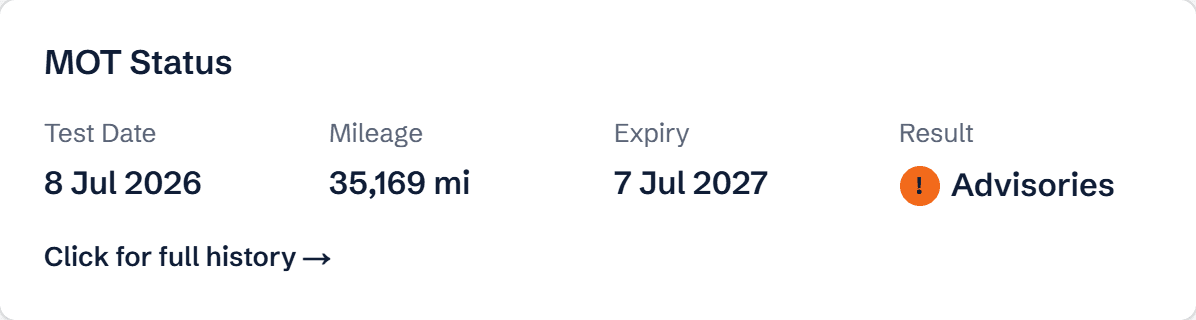
MOT Status card showing the last test date, mileage, expiry and whether advisories were recorded Check the history
Read the MOT history for mileage and advisories, and run a history check for finance, write-off and stolen records (£2.50 on DealerPricing). Outstanding finance or a write-off changes the deal entirely.
Work out the offer
Trade value minus the total work needed minus an amount you hold back for what you could not see. Then take off any finance settlement: what is left is the customer’s equity. The calculator on this page does it for you.
Decide: retail it or send it to the trade
Check how fast that model sells. If identical cars sell quickly and the work is sensible, retail it. If they sit for months, or the work is heavy, price your offer for a trade exit.
Used car stock turn calculator →
What you’ll see
- Trade poor, average and clean values and a part-exchange figure for the exact car
- Days to sell and market rating, to decide retail or trade
- MOT history with advisories and mileage at every test
- Finance, write-off and stolen records from a £2.50 history check
- Manufacturer service history on Pro plans
Part-exchange terms explained
- Part-exchange (PX)
- A customer’s car taken as part payment for the car they are buying. Also called a trade-in.
- Appraisal
- The inspection and pricing of a part-exchange: condition, history, work needed and value.
- Settlement figure
- What the customer still owes the lender to clear the finance on their car. It must be paid before the car is yours.
- Equity
- The part-exchange offer minus the settlement figure. When it is negative, the customer owes more than the car is worth (negative equity).
- Overallowance
- Offering more than the car is worth as a way of giving a discount on the car being sold. It hides the real deal and is easy to lose track of.
- Reconditioning (recon)
- The work needed to make the car ready to sell. On a part-exchange it comes off the offer.
- Hold back
- An amount kept off the offer for faults you could not see and the risk of the car taking longer to sell.
Ready to try it?
Basic 100 £70 a month, Pro 100 £99. First month half price, no contract, no VAT added.
Frequently asked questions
What is a part-exchange appraisal form?
A checklist a dealer fills in while inspecting a customer’s car: documents, condition panel by panel, tyres, interior, road test, history checks and the costs of putting faults right. It ends with the trade value, the work needed and the offer.
Where can I get a free part-exchange appraisal form PDF?
Download it from this page. It is a one-page A4 form with space for your dealership name, the customer and vehicle details, every inspection area, the checks and the offer calculation. Print as many as you need.
How do dealers value a part-exchange?
They find the trade value for the car’s actual condition and mileage, take off the cost of the work it needs and an amount for risk, and check the history for finance or a write-off. How fast that model sells decides whether they retail it or send it to the trade.
How much below trade value should a part-exchange offer be?
By the cost of the work the car needs plus a sensible amount for what you could not see. A tidy car with full service history that sells quickly can be offered close to trade value; a car needing work, or one that sells slowly, needs a bigger gap.
What is a PX valuation?
PX is trade shorthand for part-exchange. A PX valuation is the price a dealer will allow for a customer’s car against the one they are buying, usually close to the trade value adjusted for condition.
What if the part-exchange has outstanding finance?
Get a written settlement figure from the lender, deduct it from your offer and settle it directly so the finance is cleared. If the settlement is more than the offer, the customer has negative equity and must cover the difference.
What is overallowance on a part-exchange?
Giving more for the part-exchange than it is worth so the customer feels they got a better deal, while the discount really comes off the car you are selling. Record the true value on the form so you know the real margin on both cars.
What should I check on a part-exchange car?
The logbook and keeper, keys, service history, MOT history and advisories, tyres and brakes, bodywork and wheels, warning lights, electrics and a road test, plus a history check for finance, write-off and stolen records.
Should I retail a part-exchange or send it to auction?
Compare the work needed and the days to sell for that model. A quick seller that needs little work is usually worth retailing. A slow seller, an old car outside your usual stock, or one needing heavy work is often better sent to the trade, and your offer should reflect that.
Can I value a part-exchange online?
Yes. A DealerPricing search on the registration and mileage gives trade, retail and part-exchange values from live and sold UK dealer listings, with days to sell. The calculator on this page then turns the trade value into an offer.
Do franchise and group dealers use the same appraisal process?
The steps are the same: value, inspect, price the work, check the history, decide retail or trade. Groups write it down so every site appraises the same way. A shared form and the same pricing tool at each site keep offers consistent.
Can I add my dealership name to the form?
Yes. The form has a space at the top for your dealership name and the appraiser, so it can go in the deal file or be shown to the customer.
Related guides
Terms explained
- Part exchange valuePart exchange value is the amount a dealer offers against a customer's existing vehicle when they buy a new one - usually equal to or slightly below the trade valuation.
- Trade valuationA trade valuation is the price a UK motor trader would pay for a vehicle as trade stock - typically the wholesale or auction value rather than the retail (forecourt) asking price.
- Outstanding financeOutstanding finance means a UK vehicle has an active hire purchase, PCP or other finance agreement registered against it - and the finance company has the legal right to repossess the vehicle even after sale.
- V5C logbookThe V5C is the official UK vehicle registration document issued by DVLA, showing the registered keeper, vehicle technical details and ownership history.