Pricing & valuations for dealers
How to buy cars at a trade auction: maximum bid, buyer’s fees and checks
Set your maximum bid before the car comes up. Take the price it will retail for, subtract the profit you want, prep, transport and the buyer’s fee, and stop bidding there. Read the condition report and check the MOT, finance and write-off history first, because auction cars are usually sold as seen with little comeback.
Buyer's fee at that bid: £300. Check the auction's own fee table (fees often carry VAT and change with the hammer price). With a subscription, the dashboard gives the retail figure for the exact car and mileage.
Costs to put in your maximum bid
| Cost | How it is usually charged | What to check before you bid |
|---|---|---|
| Buyer’s fee | A fixed amount that rises with the hammer price, or a percentage, usually plus VAT | The auction’s current fee table for that sale |
| Online bidding fee | An extra charge on some online and live-online sales | Whether it applies to the way you are bidding |
| Assurance or inspection | Optional add-ons on some sales | What is covered and for how long |
| Transport | Your own fuel and time, or a delivery quote | Collection deadline and delivery cost to your site |
| Storage | A daily charge once the collection deadline passes | How many days you have to collect |
| Prep and MOT work | Your own costs after purchase | Condition report, MOT history and advisories |
Fees and terms differ between auctions and change during the year. Always read the fee table and terms for the sale you are bidding in.
Step by step
Register as a trade buyer
Most trade auctions ask for your business details, proof of identity and address, and sometimes proof that you are in the motor trade, before you can bid. Some ask for a deposit or a payment card. Do this a few days before the sale, not on the morning.
Read the catalogue and the condition report
Check the grade or damage report, recorded mileage and whether it is warranted, number of keys, whether the logbook (V5C) and service history are present, and any declared category or history marker. Photos hide a lot, so treat anything not shown as unknown.
Check the history yourself
Use the registration to check the free MOT history (mileage at every test, advisories, failures) and run a full history check for finance, write-off, stolen and plate change records. On DealerPricing a history check costs £2.50 from your account balance.
Free MOT and DVLA check →Price the car from the market, not the catalogue
Search the registration and mileage. Look at the trade, retail and auction values, then at identical cars for sale and recently sold, and how many days they took to sell. A guide price in the catalogue may be weeks old; the market today is what you will sell into.

The dashboard registration search with the registration and optional mileage fields Work out your maximum bid
Retail price minus the profit you want, prep, transport and the buyer’s fee at that bid is the most you can pay. Use the calculator on this page, write the number next to the lot and stick to it, however the bidding feels.
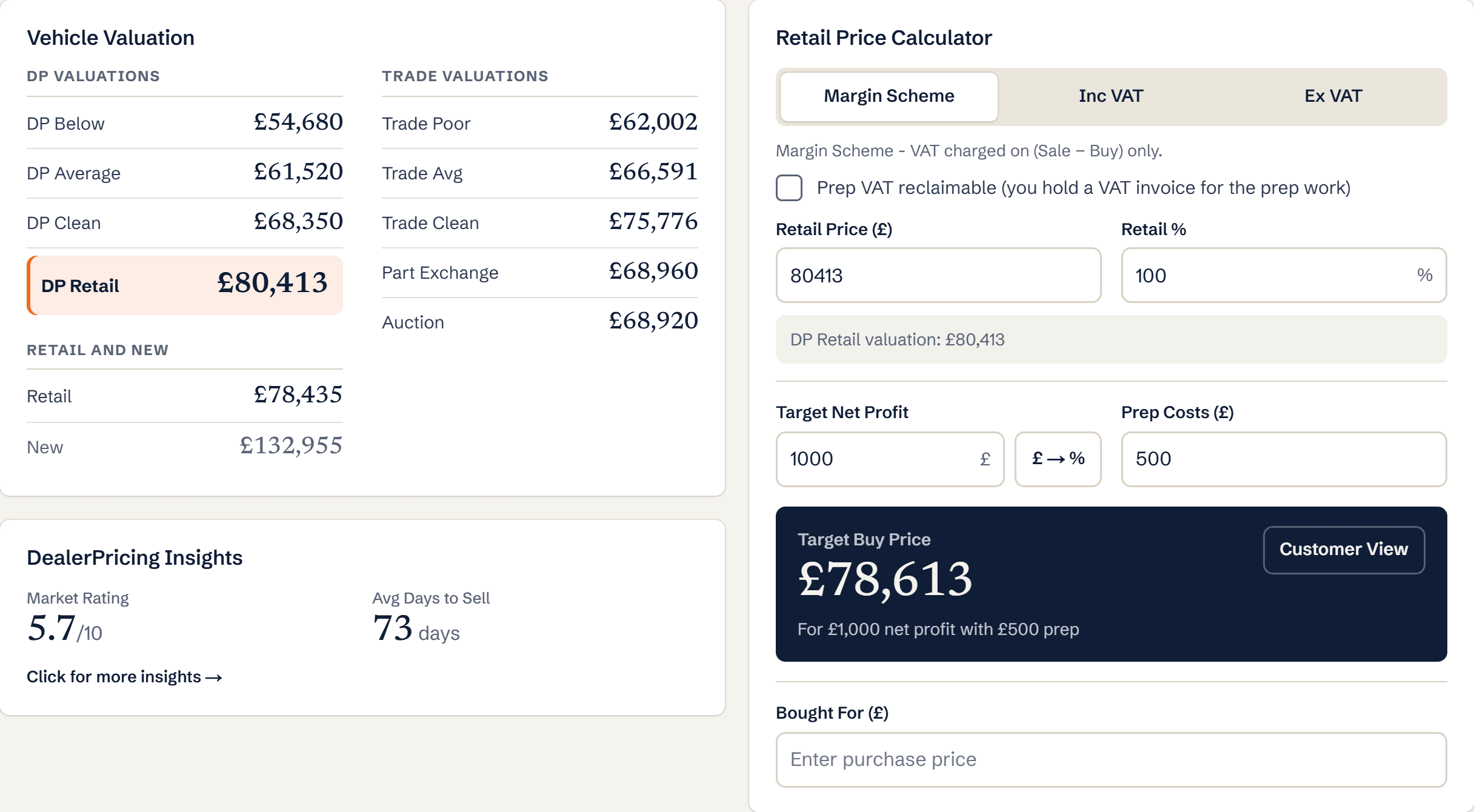
The retail price calculator with margin scheme toggle, retail price, target profit and prep cost Bid, then pay and collect on time
Stop at your number. If the car does not reach its reserve you may be offered it on a provisional bid; only accept if it still fits your maximum. Pay within the auction’s terms and collect before storage charges start.
What you’ll see
- Trade poor, average and clean values plus an auction figure for the exact car
- Retail value and the cars it will compete with when you sell it
- Sold prices and days to sell for identical cars
- Finance, write-off and stolen records from a £2.50 history check
- MOT history, advisories and mileage at every test
Auction terms explained
- Hammer price
- The winning bid when the auctioneer closes the lot. Fees are added on top.
- Buyer’s fee
- What the auction charges the buyer on top of the hammer price. It usually rises with the price and often carries VAT.
- Reserve
- The lowest price the seller will accept. A car can be bid on and not sell if the reserve is not met.
- Provisional bid
- A highest bid that did not reach the reserve. The auction takes it to the seller, who can accept or refuse it after the sale.
- Condition report or grade
- The auction’s record of damage and condition. A grade gives a quick summary; the detail matters more.
- Sold as seen
- You buy the car in the condition it is in, with limited or no comeback unless something was described wrongly.
- Clean trade value
- The trade value for a tidy car with sensible mileage for its age. Catalogues often quote a guide figure like this; check it against the market today.
- Warranted mileage
- Mileage the seller says is correct. Unwarranted mileage means nobody vouches for it, so check the MOT history.
Ready to try it?
Basic 100 £70 a month, Pro 100 £99. First month half price, no contract, no VAT added.
Frequently asked questions
What do dealers pay for cars at auction?
Usually around the trade value for the car’s condition, plus the buyer’s fee. A clean, popular car that sells quickly can go above guide prices, while tired or slow-selling cars go well below. The only safe number is your own maximum, worked back from what the car will retail for.
How much are car auction buyer’s fees?
They vary by auction and by price. Most use a fee table where the fee rises with the hammer price, and VAT is normally added to the fee. Online bidding can carry an extra charge. Read the fee table for the sale before you bid and put the fee into your maximum bid.
How do I work out how much to bid on a car at auction?
Start with the price it will retail for, then take off the profit you want, prep and MOT work, transport and the buyer’s fee. What is left is your maximum hammer price. The calculator on this page does this sum, including fees charged as a percentage of the bid.
Can anyone buy cars at a trade auction in the UK?
Some auctions and sales are open to the public, but many trade sales and online trade platforms are only for registered motor traders. Expect to show business details and identification. Register your business before you plan to buy.
Is it cheaper to buy cars at auction?
Often, but not always once fees, transport and the risk of unknown faults are counted. Auction cars come with less information and less comeback than a car bought from a dealer, so the price has to be low enough to cover that risk.
What does sold as seen mean at a car auction?
You buy the car in whatever condition it is in. Unless a fault or the description was misrepresented, you normally cannot return it. That is why condition reports, MOT history and a history check before you bid matter so much.
What is a provisional bid at a car auction?
If bidding stops below the reserve, the auction can record your bid as provisional and take it to the seller. If they accept, you have bought the car. Only leave a provisional bid you are happy to pay.
Should I trust the guide price in the auction catalogue?
Use it as a starting point only. Guide figures are often published monthly and do not show how many identical cars are for sale today or how fast they are selling. Check the live market for the exact registration and mileage before you set your maximum.
What checks should I do before bidding online?
Read the full condition report and photos, check the MOT history for mileage and advisories, run a history check for finance and write-offs, confirm keys, logbook and service history, and price the car against identical cars for sale and sold.
Can I value a car on my phone at the auction?
Yes. DealerPricing runs in your phone’s browser. Enter the registration and mileage for trade, retail and auction values, the cars it will compete with and the days to sell, then run a history check from the same screen.
How quickly should an auction car sell once I have prepped it?
Judge it against the days to sell for that model. Across all car types, the typical used car type priced by UK dealers on DealerPricing sold in a median of 28 days from being advertised in September 2026. A model that usually takes twice as long needs a lower bid.
Should I buy Cat N or Cat S cars at auction?
Only with a clear repair plan and price. Categorised cars sell for less and more slowly, and buyers must be told the category. Check the damage report closely, cost the repair properly and lower your maximum to allow for the slower sale.
Related guides
Terms explained
- Trade valuationA trade valuation is the price a UK motor trader would pay for a vehicle as trade stock - typically the wholesale or auction value rather than the retail (forecourt) asking price.
- Category N write-offCategory N means a UK vehicle has been written off due to non-structural damage - cosmetic, electrical or component-level - and can be repaired and legally returned to the road.
- MOT historyMOT history is the record of every annual MOT test a UK vehicle has had since 2005, including pass/fail status, mileage at each test, expiry dates, advisories and recorded defects.