Pricing & valuations for dealers
How to start car flipping in the UK: a starter guide for part-time traders
Start small: register as self-employed, insure yourself for the motor trade and buy one car you know will sell quickly. Before every purchase, check what identical cars sell for, how fast they sell and the car’s history, then work out your profit after fees, prep and advertising. If too little is left, walk away.
Total cost £5,750. Profit = sale price minus everything you spent. Income Tax is due on profit; ask an accountant about your own position.
One flip, every cost (example figures)
| Item | Amount | What to check |
|---|---|---|
| Sale price | £6,500 | What identical cars with similar mileage actually sold for, not the highest asking price |
| Price you pay | £4,800 | Your maximum, worked out before you view or bid |
| Buyer’s and auction fees | £350 | The fee table for that sale, plus VAT on the fee |
| Transport or fuel | £120 | Collection, delivery or train fare and fuel |
| Prep, repairs and MOT | £400 | Tyres, brakes, service, MOT work, smart repairs, valet |
| Advertising and other | £80 | Listing fees, photos, warranty or breakdown cover |
| Profit after costs | £750 | Before Income Tax, insurance and your time |
Example figures to show the sum, not averages. The calculator above uses the same numbers; change them to test your own deal.
Step by step
Know when you count as a trader
There is no fixed number of cars you can sell privately before you become a trader. If you buy cars mainly to sell them at a profit, you are trading, and you must sell cars that are of satisfactory quality, as described and roadworthy, and give buyers their consumer rights, including the 30-day short-term right to reject. Advertising trade cars as private sales is a criminal offence.
Is buying and selling cars profitable in the UK? →Set the business up properly
Register with HM Revenue and Customs as a sole trader or form a company. Get motor trade insurance (part-time policies exist) before you drive stock. Apply to DVLA for trade plates if you will move untaxed or unregistered cars on the road. Keep every receipt from day one, because your profit for tax is sales minus costs.
Choose cars you can sell quickly
Stick to popular, simple cars you understand and that cost little to fix. Speed matters more than margin when your money is limited: the typical used car type priced by UK dealers on DealerPricing sold in a median of 28 days from being advertised in September 2026, and a car that sits for two months eats your profit in fuel, insurance and time.
UK used car days to sell, September 2026 →Find your stock
Most traders buy from trade auctions (on site and online), dealer-to-dealer sales, dealers’ unwanted part-exchanges and private sellers. Salvage auctions sell damaged and categorised cars, which suit people who can repair and prove the repair. Every source has fees and risks, so compare the all-in cost with what the car will sell for.
How to buy cars at a trade auction →Price the car before you buy it
Look at identical cars for sale now and recently sold, with similar mileage, and how many days they took to sell. Then work back: sale price minus the profit you need, prep, fees and transport is the most you can pay. Write it down and do not go over it.
Work out your maximum buy price →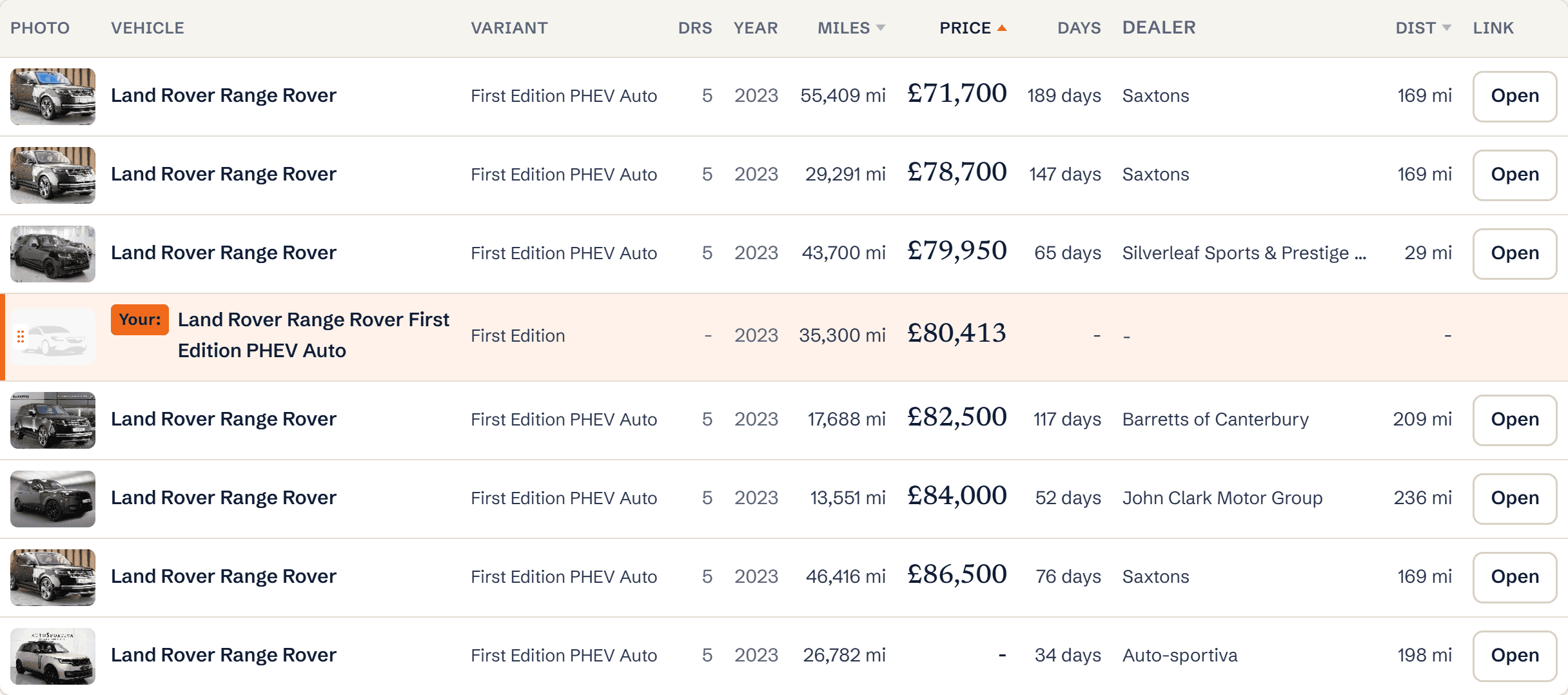
The live listings table with price, mileage, days listed, dealer and distance for cars like the one being priced Check the car’s history and condition
A car with outstanding finance can be taken back by the lender, and as a trader you do not get the protection a private buyer has. Check the free MOT history for mileage and advisories, run a full history check (£3.99, or £2.50 for DealerPricing subscribers) for finance, write-off and stolen records, and confirm the service history before you pay.
Run a vehicle history check →Prep it, advertise it honestly, review the price
Fix what a buyer will notice, take clear photos in daylight and describe the car accurately, including any history record. Price close to what identical cars sold for. If it has not had serious interest within about two weeks, look at the price again rather than waiting.
What you’ll see
- What identical cars are advertised for and what they sold for
- How many days similar cars took to sell, and a market rating out of 10
- Trade, retail, part-exchange and auction values for the exact car and mileage
- History checks at £2.50 each from your account balance
- Free MOT history with mileage at every test
- A retail price calculator that works back to your maximum buy price
Car flipping terms explained
- Car flipping
- Buying a used car below its market value, preparing it and selling it on at a profit. Done regularly, it is trading, with the same legal duties as any dealer.
- Trader
- Anyone buying and selling cars as a business. The test is what you are doing, not how many cars you sell.
- Motor trade insurance
- Insurance that covers you to drive cars you own for business and, on some policies, customers’ cars and test drives. Ordinary car insurance usually does not cover stock.
- Trade plates
- Red-on-white plates issued by DVLA to motor traders so they can drive untaxed or unregistered vehicles on the road for business reasons.
- Trade value
- What a dealer would pay for a car to put into stock. Your buy price should be at or below it.
- Retail value
- What the car sells for to a private buyer once it has been prepared. The gap between trade and retail pays for prep, fees and profit.
- VAT margin scheme
- Once you are VAT registered, you can usually charge VAT on the difference between what you paid and what you sold for, rather than the full price. The VAT is one sixth of that difference.
- Days to sell
- How long similar cars take to sell from being advertised. The longer it is, the less you should pay.
Ready to try it?
Basic 100 £70 a month, Pro 100 £99. First month half price, no contract, no VAT added.
Frequently asked questions
Is car flipping legal in the UK?
Yes. Buying and selling cars for profit is legal, but once you do it as a business you are a trader. You must register for tax, sell cars that are of satisfactory quality and as described, give buyers their consumer rights and never pretend to be a private seller.
How many cars can you sell privately in a year before you are a trader?
There is no legal number. The figure people quote online is a myth. What counts is intention: if you buy cars mainly to sell them at a profit, you are a trader from the first car, and Trading Standards looks at your pattern of buying and selling, not a count.
Is car flipping profitable in the UK?
It can be, but the profit is made when you buy, not when you sell. Fees, prep, transport, advertising, insurance and the cars that take longer to sell than you planned all come out of the gap. Work out the profit on every car before you buy it, using the calculator on this page.
How much money do I need to start car flipping?
Enough to buy one car, prepare it, insure yourself and keep a reserve for the repair you did not expect. Starting with one cheaper, popular car keeps your money moving and limits the damage of a bad buy while you learn.
Do I need motor trade insurance to flip cars?
If you drive the cars you are selling, yes, in practice. Personal car insurance normally covers named cars for social use, not stock you are trading. Part-time motor trade policies are designed for people who sell a few cars alongside another job.
Do I need a licence to sell cars from home?
There is no licence to sell used cars in the UK. You do need to register for tax, insure yourself properly and follow consumer law. If you have customers visiting or cars parked on the street, check your council’s rules and your mortgage or tenancy terms.
Do I pay tax on cars I flip?
Yes. Profit from trading is taxable. As a sole trader you must register for Self Assessment once your trading income (sales, before costs) passes £1,000 in a tax year, which one car can do. VAT registration is compulsory once your taxable turnover passes £90,000 in a rolling 12 months.
What are the best cars to flip in the UK?
Cars that sell quickly and cost little to put right: popular small hatchbacks and family cars with simple, reliable engines and plenty of buyers. Check the days to sell for the exact model before you buy. A rare or complicated car can look cheap and then take months to sell.
Where do car flippers buy cars?
Mainly trade auctions, online dealer-to-dealer sales, dealers’ unwanted part-exchanges and private sellers. Many trade auctions ask for proof that you are a motor trader before you can bid, so register your business first.
How do I know what to pay for a car I want to flip?
Find what identical cars with similar mileage sold for, take off the profit you want, prep, fees and transport, and that is your maximum. A DealerPricing search shows the live and sold cars, the days to sell and the trade and retail values for the exact registration.
What app do car traders use to value cars?
Traders use trade price guides, valuation tools linked to advertising, and live-market tools such as DealerPricing. DealerPricing runs in the browser on your phone, so there is nothing to download: enter the registration at the auction or on the driveway and the figures come back in seconds.
Should I flip Cat S or Cat N cars?
Only if you can repair them properly, prove the repair and price them fairly. Categorised cars sell for less and take longer to sell, and you must tell buyers about the category. For a first flip, a car with a clean history is simpler.
Is DealerPricing worth it if I only sell one or two cars a month?
It depends on how many cars you look at, not how many you sell. Basic 100 is £70 a month for 100 searches (about 70p a search), repeat searches of the same registration in the month are free and history checks are £2.50 instead of £3.99. If you only look at a car or two a month, the free MOT check and a one-off history check may be all you need.
Is there a free trial?
There is no free trial. The first month is half price (£35 on Basic 100), there is no contract and you can cancel at any time from your account. The demo shows a full sample search before you pay.
Related guides
Terms explained
- Trade valuationA trade valuation is the price a UK motor trader would pay for a vehicle as trade stock - typically the wholesale or auction value rather than the retail (forecourt) asking price.
- Outstanding financeOutstanding finance means a UK vehicle has an active hire purchase, PCP or other finance agreement registered against it - and the finance company has the legal right to repossess the vehicle even after sale.
- Category S write-offCategory S means a UK vehicle has been written off due to structural damage but has been (or can be) repaired and legally returned to the road.