How to compare your stock with the market and reprice
How dealers benchmark stock against live comparables: price position, days listed, supply and days to sell, plus a simple rule for when to reduce a car.
To compare your stock with the market, search each car's registration, see where its price sits among the comparable cars for sale near you, check how long those cars have been listed and how many sold recently, and set a review date from the average days to sell. DealerPricing shows all of that on one screen, so a whole forecourt can be benchmarked in an hour.
Key takeaways
- Price position is relative. A car is cheap or expensive only against the comparables buyers see alongside it.
- Days listed on competitors' cars shows which prices the market has already rejected.
- Average days to sell is the review trigger: if your car passes it unsold, reprice.
- Supply and demand ratings tell you whether to hold, reduce or trade a car out.
- Sold prices, not asking prices, are the benchmark for the reduction.
Why stock ages
Most overage stock was priced correctly on the day it was listed and never revisited. Competitors reduce, a dozen similar cars arrive at auction, the model gets a facelift, and the car that was mid-market at £11,995 is now the most expensive of fifteen. The cost is not only the eventual reduction; it is the stocking loan interest, the second set of photographs and the space that a faster car could have occupied. A weekly benchmark against the live market catches the drift in week two rather than month three.
Step 1: search the car and read the comparables
Enter the registration and mileage on the DealerPricing dashboard. The listings table shows every comparable car for sale now with price, mileage, days listed, dealer and distance from your postcode. Use Adjust Filters to set the radius your buyers actually travel, the mileage band and the fuel and gearbox, and tick No Write-offs so damaged-repaired cars do not drag the average down. Sort by price. Your car's position in that list is its price position, and that is what a buyer on a marketplace sees. The filters guide explains each control.
Step 2: sort by days listed
Sort the same table by days listed. The cars at the top have been on sale longest, and their prices are the ones the market has already declined. If your car is priced level with a competitor's that has sat for 90 days, you have priced it to sit for 90 days too. The cars listed recently at lower prices are the ones you are competing with this week. This single sort is the fastest overpriced-stock detector available, and the retail pricing guide shows it in use.
Step 3: check what actually sold
Switch Listing Type to Sold. These are comparable cars that left the market in the last 90 days, with the prices they were showing when they went. Asking prices tell you what competitors hoped for; the sold view tells you what buyers paid. When the sold prices cluster £600 below the current asking prices, the market has moved and a reduction to the sold level, not a token £250, is what clears the car. The sold prices guide covers the view in detail.
Step 4: read the Insights tab
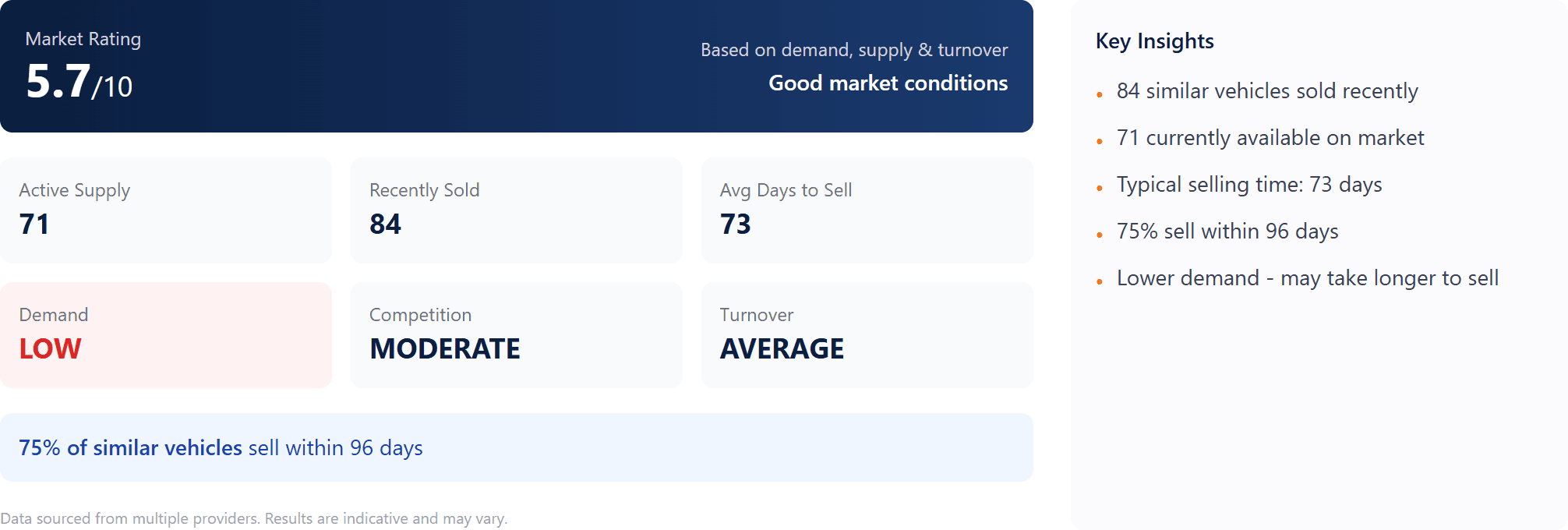
The Insights tab summarises the market for that car. Active supply is the number of comparable cars for sale. Recently sold is how many cleared in the last 90 days. Average days to sell is the review trigger. The demand, competition and turnover ratings put those numbers into words, and the market rating out of ten combines them. A car with 40 comparables, 60 sold in 90 days and a 27-day average is in a fast market and can hold its price for a fortnight. A car with 180 comparables, 30 sold and an 80-day average is in a buyer's market where the first sensible price wins. The insights guide explains each rating and the share-of-cars-sold-within-30-60-90-days bars.
Step 5: set a rule and a review date
A simple rule works: price at or slightly under the comparable average for the car's mileage, note the average days to sell as the review date, and if the car has not sold by then, reprice to the sold level. Repeat the check every week on the whole forecourt, because the comparables move every day. Dealers using this rule stop arguing about individual cars and start managing stock turn as a number.
When to reduce, hold or trade out
Reduce when your price position is above the middle of the comparables and days listed on your car is past the market average. Hold when the car is priced at or below the middle, supply is low and the average days to sell is longer than your car has been listed. Trade out when supply is high, demand is rated low, sold volume is falling and the reduction needed to reach the sold level wipes out the margin. The Insights screen makes the third case obvious before the car has cost three months of interest.
Using the same data when buying
The benchmark that tells you a car is overpriced on your forecourt tells you the same thing at the auction. Before bidding, check active supply and days to sell for the exact car. Fast-turning models with low supply justify a bid at the top of the trade band; slow models with high supply do not, whatever the guide says. The trade valuation tool shows the trade bands and the insights on the same search. Buying with the market in view is the surest way to have less overage stock to reprice later.
A weekly routine that takes an hour
Monday morning: open Recent Searches, which holds every car you have searched, and re-run each stock car. The dashboard reloads it with fresh comparables. For each car, note the price position, the days listed on the closest comparables and the average days to sell. Reprice anything past its review date to the sold level. Flag anything where supply has jumped. An hour a week keeps a forty-car forecourt priced against this week's market rather than the market it was bought in.
Frequently asked questions
How long should a used car take to sell?
It depends on the model and the market. DealerPricing shows the average days to sell for comparable cars on every search; fast-turning models average 25 to 35 days and slow ones 70 days or more. Use the figure for your car as the review date: if it has not sold by then, the price needs to move.
When should a dealer reduce the price of a used car?
When the car has been listed longer than the average days to sell for comparable cars, or when its price sits above the middle of the comparables that buyers see alongside it. Reduce to the level similar cars actually sold for in the last 90 days rather than by a token amount, because a small cut that leaves the car above the sold level does not clear it.
How do I know if my used car is overpriced?
Search the registration on DealerPricing, filter the comparables to your radius and mileage band, and sort by price and then by days listed. If your car sits in the top third on price and the competitors at that level have been listed for longer than the market average, it is overpriced for the current market.
What is a good stock turn for a used car dealer?
Many dealers aim to turn stock within 45 to 60 days, but the right target varies by model, so compare each car against the average days to sell for its comparables rather than a single forecourt-wide figure. Cars past their model's average are the ones costing money.