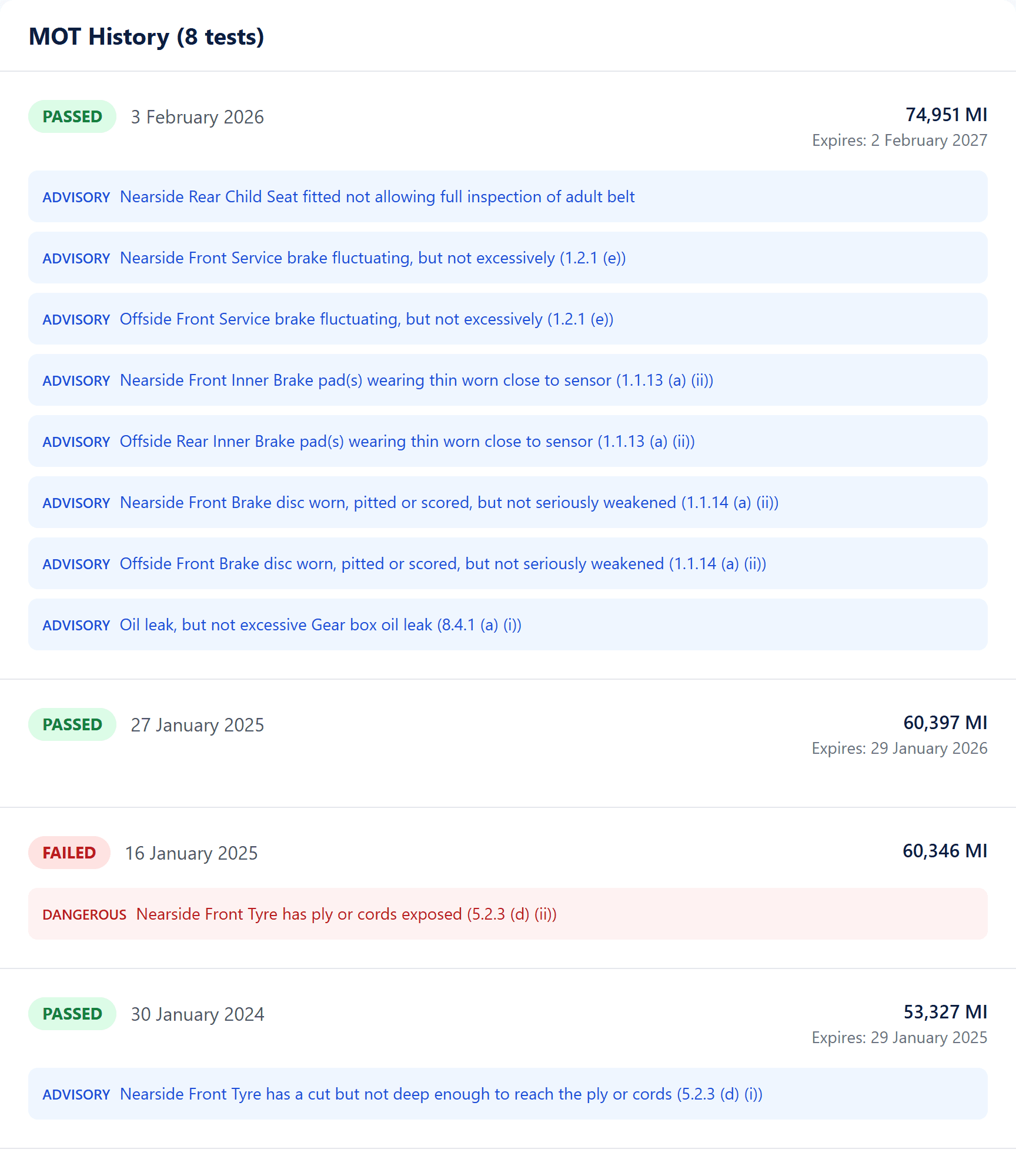
Free MOT check: how to read a car's MOT history
How to run a free MOT check on any UK registration and read the result: expiry date, advisories, failures and the mileage readings that reveal clocking.
A free MOT check shows every MOT test a car has had since 2005: the date, whether it passed or failed, the mileage recorded, the expiry date and every advisory and failure in the tester's own words. Enter any UK registration into the DealerPricing free MOT check and the full history appears in seconds, with no account, email or payment, alongside the car's tax status and DVLA details.
Key takeaways
- MOT history is public government data and genuinely free; you should never pay for it.
- Advisories are the repairs the car will need soon. Cost them before you agree a price.
- The mileage at each test shows how the car was used and whether the odometer has been tampered with.
- A failed test followed by a quick pass tells you what was fixed and what was ignored.
- MOT data cannot show finance, theft or write-offs; a £3.99 history check covers those.
How to run the check
Open the DealerPricing free MOT check, type the registration and click Free Check. The result shows the car's make and year, tax status with the due date, MOT status with the expiry date, and the DVLA-registered colour, fuel, engine size, CO2, first registration date and last V5C issue date. Below that is the MOT history, newest test first. It works for any car, van or motorbike registered in Great Britain. The MOT history guide shows each part of the screen.
Reading the expiry date
The MOT Expiry tile gives the exact date the current certificate runs out. If it is within a few weeks, the seller should either put a new test on the car or the price should reflect that you will. You can have a car tested up to a month before expiry and keep the same renewal date. If the MOT has already expired, the car cannot legally be driven except to a pre-booked test, so it should not be advertised as ready to drive away. The MOT expiry guide covers the rules.
Reading advisories and failures
Each test lists its defects, colour-coded by category since May 2018. Advisories did not fail the car but tell you what is wearing out: tyres near the limit, brake pads wearing thin, slight corrosion, a small oil leak. Minor defects passed with a note to fix soon. Major and dangerous defects failed the test and had to be repaired before the car could pass. Read the last two or three tests together. Two tyres and a set of pads is a few hundred pounds to negotiate off the price. Corrosion advisories on the underside or subframe that appear on test after test are a different conversation. The advisories guide explains each category.
A failed test with a pass a few days later is normal; the fail lists what was wrong and the pass confirms it was fixed. A pattern of fail, pass, fail across several years suggests an owner who fixed only what forced them to.
Reading the mileage readings
The odometer reading is recorded at every test, so the history shows the mileage rising year by year. Read it from the oldest test to the newest. Two things should worry you. A reading that is lower than the one before means the odometer went backwards, which is either a tester's typing error or a clocked car, and you need to know which. A car that covered 12,000 miles a year for five years and then 1,500 in the year before sale may have been clocked recently, or may have been off the road with a fault. The mileage history guide shows what a normal and an abnormal pattern look like.
Checking the tax status at the same time
The same result shows whether the car is taxed, untaxed or declared SORN, with the date the tax runs out. A car on SORN cannot be driven on the road, and tax does not transfer with the car, so you will need to tax it before driving away regardless. The tax status guide explains the statuses.
What the free check cannot tell you
MOT and DVLA data describe the car's condition and registration. They say nothing about whether the car is stolen, has finance owing, has been written off by an insurer, or has had plate changes, because those records are held on private registers that charge for every search. A car with a perfect MOT history can still be repossessed by a finance company. For a car you are about to pay for, the £3.99 vehicle history check searches those registers and reports each marker with a PDF.
Using the check before you go to see a car
Run the free check on the registration in the advert before you travel. If the MOT history shows a mileage drop, a string of corrosion advisories or an expired test the advert did not mention, you have saved a journey. If it is clean, take the advisory list with you and look at the items it mentions. Sellers respond differently to "the last MOT advised the rear tyres" than to a vague request for a discount.
Frequently asked questions
Is the MOT history check really free?
Yes. MOT history is public data published by the DVSA, and the DealerPricing free check shows it with no account, email or payment. It is funded by the paid services motor traders use, such as history checks and valuations.
How far back does MOT history go?
Records go back to 2005 for most vehicles, so a car registered before then will show tests from 2005 onwards. Cars under three years old have not had a test yet, so their history starts at their first MOT.
What is the difference between an advisory and a failure?
An advisory is a defect the tester noted that did not fail the car but will need attention soon. A major or dangerous defect failed the test and had to be repaired before the car could pass. Minor defects passed with a note. Advisories are your negotiating list; failures tell you the car's history of neglect and repair.
Does the free check show if a car is stolen or has finance?
No. Those records are held by the police, insurers and finance companies and are not part of the free MOT and DVLA data. The DealerPricing vehicle history check searches them for £3.99, with no account needed, and reports stolen, finance, write-off, mileage and plate change markers.