Free MOT & DVLA checks
How to check MOT advisories and failures
Updated 3 September 2026 · 2 min read · by DealerPricing
Run a free MOT check on the registration and open the MOT history. Each test lists its defects colour-coded by category: advisory (blue), minor, major (red) and dangerous. Advisories do not fail the car but show what will need money soon; majors and dangerous defects caused a fail and had to be repaired.
Step by step
Run a free MOT check
Enter the registration and click Free Check.
Free MOT check →Open the MOT history section
Every test is listed newest first. Failed tests are marked in red; look for the retest that followed to confirm the repair.
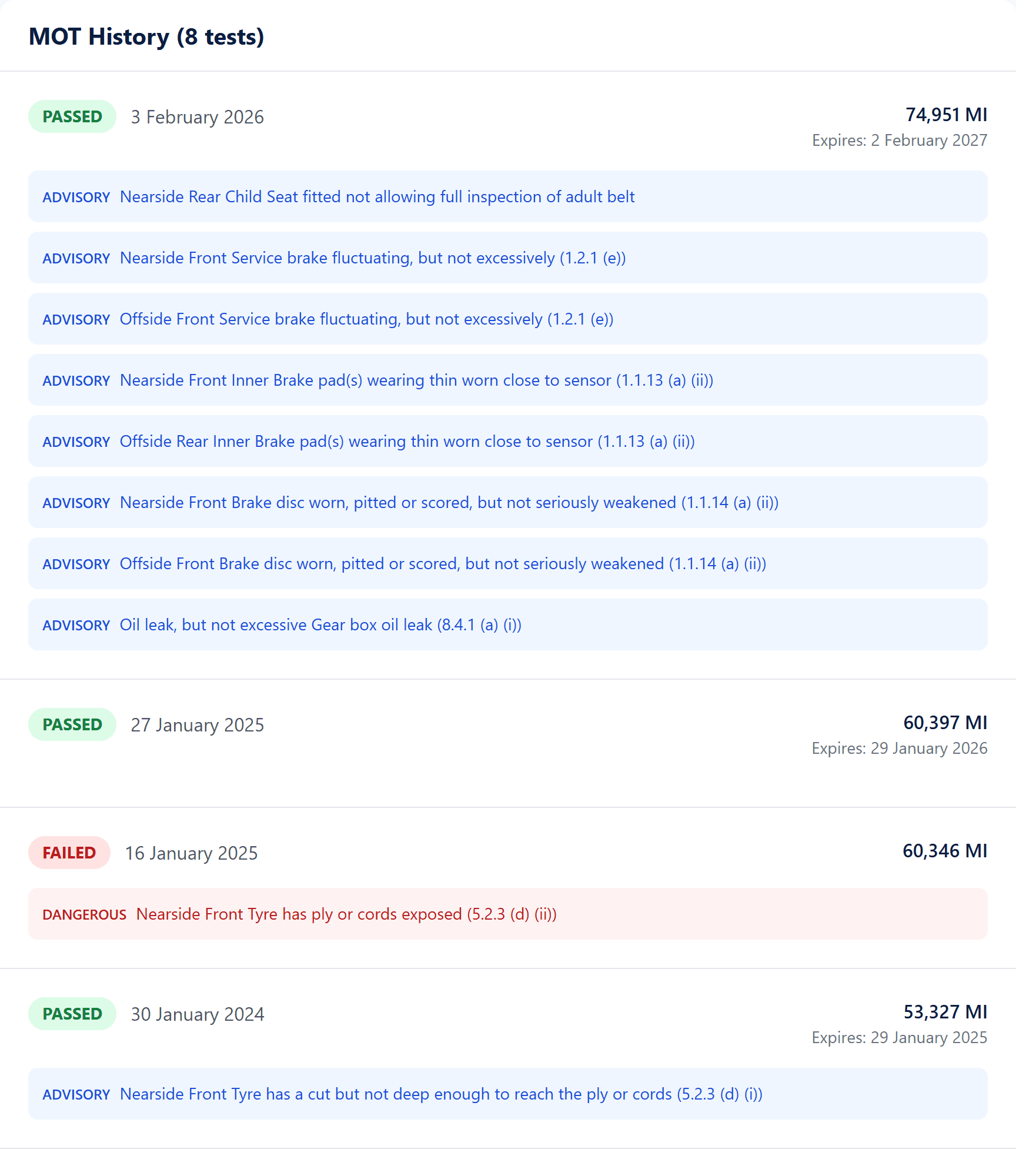
MOT history with an advisory list and a failed test showing a tyre with exposed cords Read the defect categories
Advisory: watch this. Minor: passed but fix soon. Major: failed, unsafe until repaired. Dangerous: failed and must not be driven. The DVSA introduced these categories in May 2018.
What you’ll see
- Each defect in the tester’s own words, with the inspection manual reference
- Which advisories repeat year after year
- Whether a failure was followed by a pass within days
Ready to try it?
Free, instant, no signup.
Run a free MOT & DVLA check →Frequently asked questions
Do I have to fix MOT advisories?
Not to keep the certificate, but advisories are the tester telling you what is wearing out. Tyres, brake pads and discs, and corrosion advisories usually turn into failures within a year.
What is the difference between a major and a dangerous defect?
Both fail the test. A major defect affects safety or the environment and must be fixed before the car is used. A dangerous defect means the car is an immediate risk and must not be driven at all, even to a garage, until repaired.
Can a seller hide MOT advisories?
No. Advisories and failures are recorded by the DVSA and appear on any MOT history check regardless of who owns the car. That is why the free check is worth running before viewing a car.
Are advisories a reason to walk away?
Usually not on their own. Use them to negotiate: price the repairs, and ask for evidence that older advisories were fixed. A car with the same advisory on three consecutive tests has an owner who did not maintain it.