Vehicle history checks
How to check if a car has been in an accident (UK)
There is no UK register of every accident. What is recorded is an insurance write-off: when an insurer declares a car a loss, it goes on the insurers' register with a category (A, B, S or N), which a £3.99 history check shows. Smaller repaired accidents are not recorded, so also read the MOT history and inspect the bodywork.
Cat S - Structural
Can return to the roadStructural damage (chassis, crumple zones) that has been, or can be, professionally repaired.
Should you buy one? Only with proof of repair and a price well below a clean example. Must be re-registered with the DVLA before it is driven.
Full definition of Cat S →What each check can tell you about accident damage
| Source | What it shows | What it misses |
|---|---|---|
| Vehicle history check | Insurance write-offs with category (A, B, S, N) and date | Accidents repaired without a write-off |
| Free MOT history | Advisories and failures that may follow damage | Damage repaired between tests |
| Looking at the bodywork | Repainted or replaced panels, uneven gaps | Hidden structural repairs |
| Independent inspection | Structure, alignment and repair quality | Nothing on paper, but costs more |
| Insurers' claims database (CUE) | Claims made by policyholders | Not open to buyers: only the policyholder can request their own record |
There is no single UK record of every accident a car has had.
Step by step
Check for an insurance write-off
A history check shows whether an insurer has written the car off and in which category. Cat S (structural damage) and Cat N (non-structural) cars can be repaired and sold, and must be described as such. The £3.99 report shows the category and the date it was recorded.
Insurance write-off check →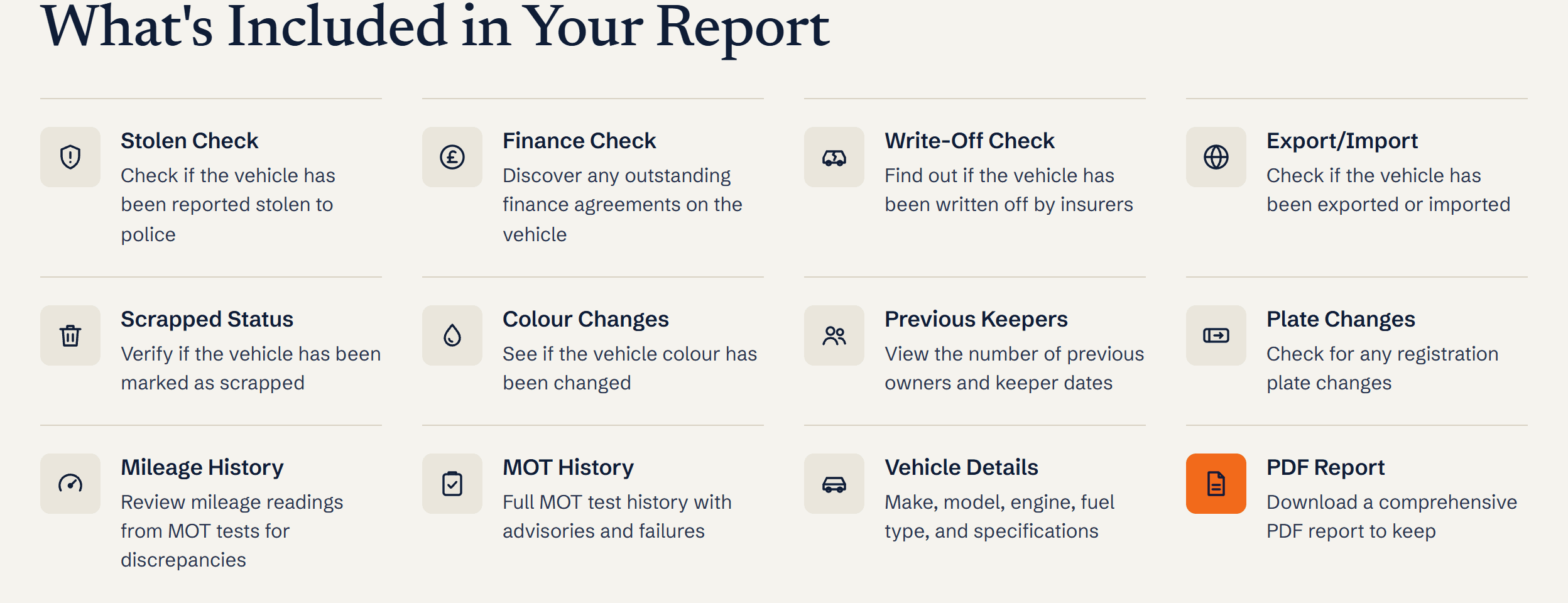
What a DealerPricing history report covers: stolen, finance, write-off, export/import, scrapped, colour changes, keepers, plate changes, mileage and MOT history Read the MOT history for clues
The free MOT history shows every test. Advisories or failures for bodywork, suspension or steering on one side, a long gap between tests, or a test soon after a repair can point to accident damage. Mileage should rise steadily.
Free MOT history check →Look at the car in daylight
Look along each side for ripples, and check that the gaps between panels are even. Paint that differs in shade or texture between panels, overspray on rubber seals or trim, and new bolts on the wings or bonnet show that a panel has been repainted or replaced.
Ask the seller directly
Ask whether the car has had any accident repairs or insurance claims, and ask for invoices. A seller who says no, when the history check or the bodywork says yes, has told you what you need to know.
Get an inspection on an expensive car
For a car where a hidden repair would cost you a lot, an independent inspection checks the structure, the alignment and repaired areas properly. Citizens Advice puts the cost of an independent report at around £120 to £250.
What you’ll see
- What is recorded about accidents in the UK, and what is not
- How to read a write-off category on a history report
- The clues in MOT history and bodywork
- When an independent inspection is worth paying for
Ready to try it?
£2.50 for DealerPricing subscribers. Report stored for 6 months with a PDF.
Frequently asked questions
Can I check if a car has been in an accident by registration?
Only if the accident led to an insurance write-off. A history check on the registration shows any write-off category and the date. Accidents repaired without a write-off are not recorded anywhere a buyer can search.
Does a history check show all accidents?
No. It shows insurance write-offs, which are recorded by insurers. A small accident paid for privately, or a claim the insurer repaired, leaves no record a buyer can see.
What is the difference between Cat S and Cat N?
Cat S means the car had structural damage, such as to the chassis or crumple zones, and was repaired. Cat N means non-structural damage, such as cosmetic or electrical. Both can be back on the road, but both affect value and insurance.
Can I see the insurance claims on a car I am buying?
No. The insurers' claims database (CUE) is about the policyholder, not the car, and only the policyholder can ask for their own record. A buyer sees write-offs through a history check.
Is a car that has been in an accident a bad buy?
Not always. A properly repaired car at the right price can be fine. The risk is not knowing: a write-off you were not told about affects the price you should pay, your insurance and what you can sell it for later.
Ready to run it? Insurance write-off check