Vehicle history checks for car dealers: what £2.50 covers
What a dealer vehicle history check covers, when to run one, how DealerPricing charges £2.50 per check, and how it compares with £19.99 branded HPI checks.
A vehicle history check for a dealer confirms, before money changes hands, that a car is not recorded as stolen, has no outstanding finance, has not been written off by an insurer, has consistent mileage and has not had its identity changed. DealerPricing runs the full check against the national databases for £2.50 per car from a subscriber's balance, or £3.99 as a one-off, with a PDF report in seconds.
Key takeaways
- A history check searches private registers that no free DVLA or MOT check can reach.
- DealerPricing checks cost £2.50 for subscribers and £3.99 one-off, against around £19.99 for branded checks.
- The report covers stolen markers on two databases, finance, write-off category, mileage, plate and colour changes, import, export, scrappage and recalls.
- Run the check at deposit and again at collection if there is a gap; finance can be registered in between.
- Reports download as PDFs and stay in the account for six months, so the buyer of the car can be given a copy.
What does a dealer history check actually search?
The phrase "HPI check" is used loosely in the trade, but HPI is one company's brand name for a vehicle provenance check. DealerPricing does not sell HPI-branded checks. It runs its own check against the same national sources: the Police National Computer, the insurers' MIAFTR register of theft and total-loss claims, the finance registers where hire purchase, PCP and conditional sale agreements are recorded, and the DVLA. The HPI alternative page sets out the comparison line by line.
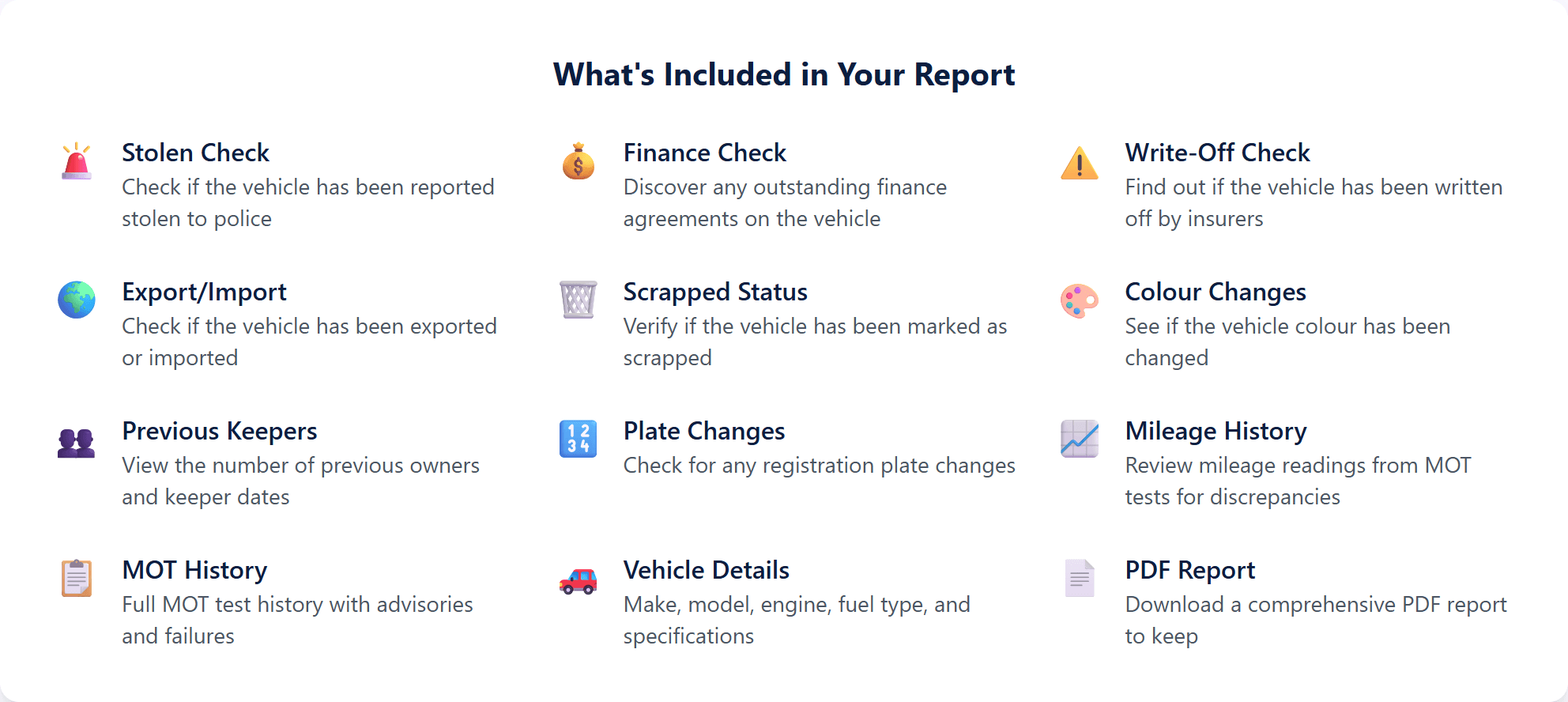
Each DealerPricing report checks twelve areas: a PNC stolen marker, a MIAFTR stolen marker, outstanding finance with lender and agreement details, insurance write-off category A, B, S or N with the date of loss, recall notices, import and export markers, scrappage, colour changes, plate changes, mileage consistency across every MOT reading, and a downloadable PDF. Each marker is shown separately, so a clear car reads Vehicle clear with every line reading Not recorded.
Why does a dealer need a history check when the free check exists?
The free vehicle check is genuinely useful. It shows every MOT test since 2005 with mileage and advisories, tax status and the DVLA-registered details. What it cannot show is anything held on a private register. Finance, theft and insurance total-loss records are held by the finance houses, the police and the insurers, and each search costs money at source. Any "free finance check" online is either DVLA data dressed up or a teaser for a paid report.
For a dealer, the exposure is real. A car sold with finance owing can be recovered by the lender from the eventual customer, who then comes back to the dealer. A Cat S car retailed as clean is a misdescription. A cloned car is a total loss. Against those outcomes, £2.50 per car is the cheapest insurance in the business.
When should a dealer run the check?
Run it at three points. First, before bidding at auction or agreeing a part-exchange, because outstanding finance or a write-off changes the valuation entirely. Second, at deposit. Third, at collection or invoice if more than a few days have passed, because a finance agreement can be registered against a car between the two. Dealers who run the check on stock before it goes on sale can hand the PDF to the retail customer, which shortens the sale and pre-empts the customer's own check.
The history check guide shows the two-click flow on the dashboard: search the registration, click History Check, and the report opens with a summary line before the individual markers.
How to read the markers
Stolen. Two lines, one from the PNC and one from MIAFTR. A hit shows the reporting force and date. Always compare the VIN on the report with the plate in the windscreen and the stamped chassis number, because a stolen car is usually sold on a cloned plate from a legitimate vehicle.
Finance. Shows the lender, agreement type, start date and a contact number. Do not pay the seller. Get a written settlement figure from the lender and either settle directly or get written confirmation the agreement is closed. The outstanding finance glossary entry explains the agreement types.
Write-off. Shows the category, insurer, loss date and reference. Cat A and B cars must never return to the road. Cat S (structural) and Cat N (non-structural) can be repaired and retailed, but must be described as such and priced well below a clean car. Category guidance is in the glossary under Cat S and Cat N.
Mileage. Every MOT odometer reading is compared. A reading that goes backwards raises a discrepancy alert. A car that covered 2,000 miles a year for six years and then 25,000 in the seventh deserves a question too.
Plate and colour changes. Neither is a problem on its own; a private plate transfer is routine. Several plate changes in a short period, or a colour change with no obvious reason, is worth a closer look at the paperwork.
Import, export and scrappage. An exported car should not be for sale in the UK. A scrapped marker means the DVLA has been told the car was destroyed. An import marker matters for warranty, specification and sometimes valuation.
What the check costs and how it is charged
Subscribers on any DealerPricing plan pay £2.50 per check, deducted from a prepaid account balance that is topped up from the billing page. There is no monthly minimum and unused balance carries over. Single markers can also be bought separately from the More Checks menu when a full report is not needed: a write-off check is £1.00, a finance check £1.25, a PNC stolen check £1.00 and a taxi check £0.25.
Anyone without a subscription pays £3.99 for the full check on the history check page, with no account required. Branded checks from the established providers are typically priced at £19.99 for a comparable report, so a dealer running 40 checks a month saves several hundred pounds.
Keeping and sharing the report
Every report is stored in the account for six months and can be re-opened free of charge from the Vehicle Checks button on the dashboard. The PDF carries the check date, the registration, the VIN and each marker's result. Attach it to the deal file, hand it to the buyer, or keep it as evidence that reasonable checks were made before the sale. For part-exchanges, the report also gives you a written basis for the offer you made.
Frequently asked questions
Is a DealerPricing history check the same as an HPI check?
It searches the same national databases, the PNC, MIAFTR, the finance registers and the DVLA, and reports the same markers. It is not an HPI-branded product; HPI is a trade mark of its owner and DealerPricing is not affiliated with it. The practical difference for a dealer is the price: £2.50 for subscribers or £3.99 one-off rather than around £19.99.
Can I check for outstanding finance for free?
No. Finance agreements are held on private registers that charge for every search, so a free check can only show DVLA and MOT data. DealerPricing includes the finance search in the £2.50 history check and also sells it on its own for £1.25 from a subscriber's balance.
How long does a vehicle history check take?
Seconds. Enter the registration, confirm the check and the report opens on screen with a Vehicle clear or Issues found summary, followed by each marker. The PDF is generated at the same time and the report stays available in the account for six months.
Should I run the check again before the customer collects the car?
Yes, if more than a few days have passed since the first check. Finance can be registered against a car at any time, and a theft report can be added after the car was bought. A second £2.50 check at handover protects both the dealer and the customer.