Service history checks: what dealers can verify online
How a digital service history check confirms a seller's claims against manufacturer records, what it cannot see, and how dealers use it to price FSH cars.
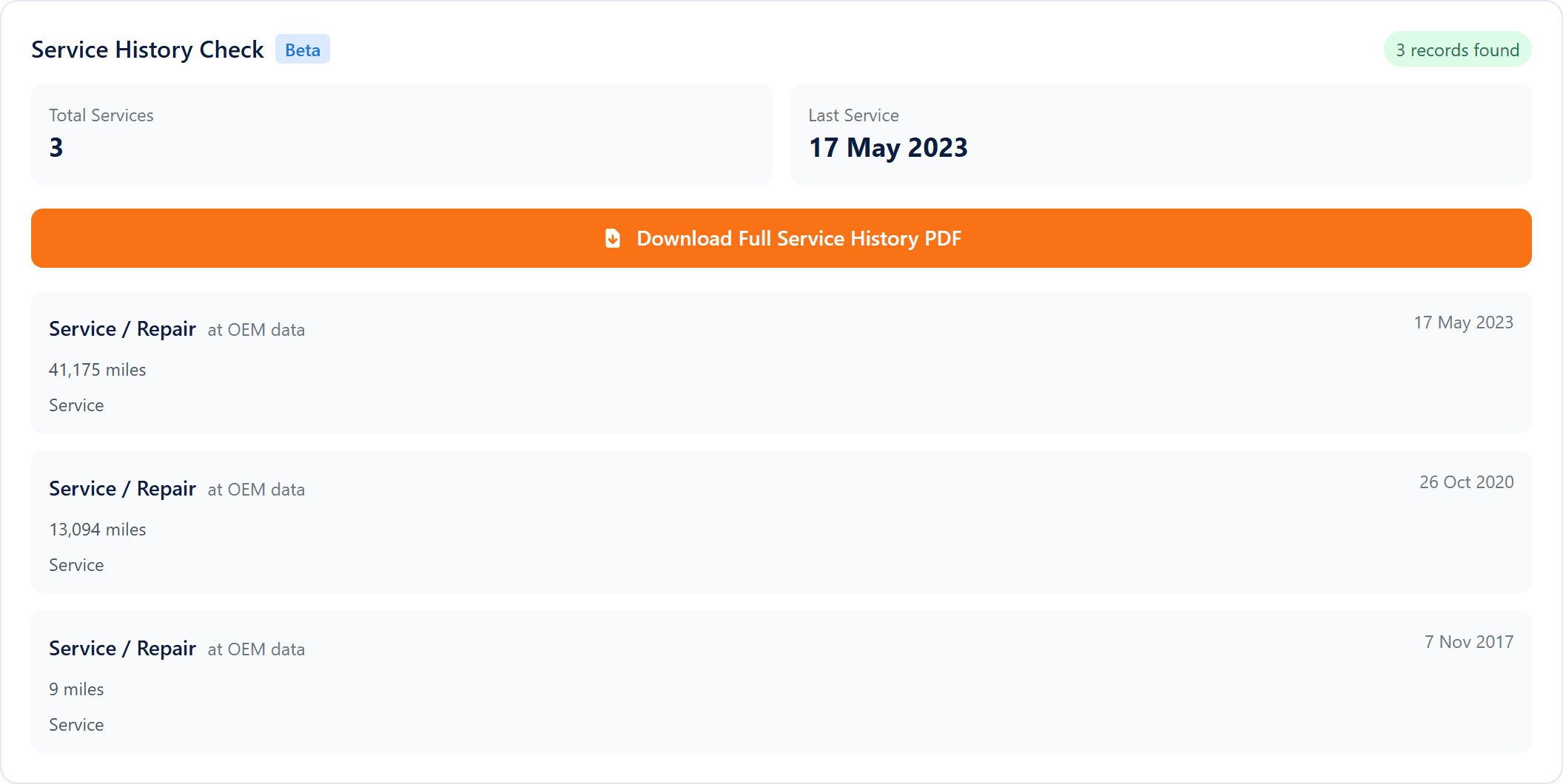
A service history check confirms whether a car's claimed service record is real by reading the manufacturer's digital service records, where franchised dealers log every scheduled service, and comparing them with what the seller says. DealerPricing includes the check on Pro plans, and it shows the confirmed service dates, mileages, dealer names and service types, plus any intervals that are missing.
Key takeaways
- "Full service history" is one of the most exaggerated claims in used car adverts and typically adds 5 to 10% to a car's value.
- Most manufacturers now keep service records digitally, so a franchised dealer's work can be verified without the paper book.
- The check confirms dates, mileages, dealer and service type, and flags missed intervals.
- Independent garage work usually does not appear, so "no manufacturer record" is not the same as "no service".
- Run it with the £2.50 vehicle history check for a complete picture of the car.
Why service history matters to the price
A car with a verifiable full service history sells faster and for more than an identical car without one, because the buyer is paying for the evidence that the car was looked after. That premium is why the claim is so often stretched. "Full service history" in an advert can mean a stamped book with every service on time, a book with two stamps and a gap of four years, or a seller's memory of an oil change. A dealer who pays a full-history premium for a car that turns out to have gaps carries the difference into stock.
How the digital service record works
Most manufacturers replaced paper service books with a central digital record from roughly 2010 onwards. When a franchised dealer services the car, it logs the date, mileage, dealer and the work done directly into the brand's system. Some brands allow approved independents to log work too. The record follows the car, not the owner, so it survives a sale, a lost book or a change of keeper.
DealerPricing's service history check reads that record for the registration and lays it out as a list: each service with its date, the mileage recorded, the dealer name and location, the type of service (minor, major, oil-only, brake fluid) and any recalls or software updates applied. Missing intervals are flagged, so a car that should have had six services and shows four is visible at a glance.
What the check confirms
It confirms the services that franchised dealers logged, which is exactly the part of a "full main dealer history" claim that carries the premium. It confirms the mileage at each service, which cross-checks the MOT readings for consistency. It shows where the car was serviced, which matters when a car is described as "one owner, local car" and the record shows services in three different regions. And it shows recall and software campaigns that were completed, which is useful on cars with known recall issues.
What the check cannot see
Work done by an independent garage that does not log into the manufacturer's system will not appear, so the result reads "no manufacturer record" for those years. That is not the same as "not serviced". For a car described as independent-serviced, the paper invoices and book are still the evidence. Older cars, generally pre-2010, will have paper records only. Brand coverage varies, and where a brand does not operate a central digital record the check returns no data rather than a false negative.
How dealers use it
At purchase, the check decides whether the full-history premium is justified. On a part-exchange, it turns "yes, it's been serviced" into a list you can read. At retail, the confirmed record is a selling tool: a printed list of main dealer services with mileages is more persuasive than a book of stamps, and it pre-empts the customer's own doubts. The check also protects the dealer against a misdescription claim; a car advertised with full service history on the strength of a verified record is described accurately.
The workflow on DealerPricing is to search the registration, open the History tab, and run the service history check alongside the MOT history that is already there. The dashboard guide shows where each section sits.
Combining it with the vehicle history check
The service history check answers "has it been maintained?". The vehicle history check answers "is it safe to buy?": stolen markers, outstanding finance, insurance write-off category, plate and colour changes, and mileage consistency across the MOT record. Together, for £2.50 plus the Pro plan's included service check, a dealer has the full picture on a car before bidding. The MOT history and tax status are free on every search.
What good and bad records look like
A good record shows a service at each manufacturer interval, mileages that rise steadily and match the MOT readings, and a recent major service or cambelt where one is due. Recall campaigns show as completed. A questionable record shows a gap of two or more intervals, a service logged at a mileage lower than an earlier MOT reading, or a cluster of services in the months before sale after years of nothing. The last pattern usually means a seller catching up to justify a "full history" advert, and the car should be priced on the years that were missed.
Frequently asked questions
Can I check a car's service history online by registration?
Yes, for brands with a digital service record. A DealerPricing service history check, included on Pro plans, reads the manufacturer's record for the registration and lists each service with its date, mileage, dealer and service type, flagging any missed intervals. Independent garage work that was never logged with the manufacturer will not appear.
What does "no manufacturer record" mean on a service history check?
It means the manufacturer's digital system holds no service entry for that period. The car may have been serviced by an independent garage that does not log into the system, or it may not have been serviced at all. Ask for invoices or the paper book for those years before accepting a full service history claim.
How much is full service history worth on a used car?
A verifiable full service history typically adds 5 to 10% to the value of an otherwise identical car, and the car usually sells faster. The premium is largest on prestige and higher-mileage cars, where buyers are most worried about deferred maintenance.
Which cars have a digital service record?
Most major manufacturers have used digital service records for cars built from roughly 2010 onwards, with coverage growing each year as brands retire paper books. Older cars and some smaller brands rely on paper records only, and for those the stamped book and invoices remain the evidence.