How dealers use MOT history to price prep and spot clocking
How to read a used car's MOT history like a dealer: cost the advisories as prep, plot the mileage readings, spot clocking and price the car right.
A used car's MOT history is the cheapest inspection a dealer can get. Every test since 2005 records the result, the mileage and the tester's advisories and failures, and DealerPricing shows all of it, with the mileage plotted as a chart, on every search and on the free vehicle check. Read properly, it prices the prep, exposes clocking and shows how the car was kept.
Key takeaways
- MOT data is free and public. Every test since 2005 is on record with mileage and defects.
- Advisories are the prep bill in the tester's own words. Cost them before you bid.
- A mileage reading that goes backwards is a discrepancy; a mileage that barely moves for years deserves a question.
- Repeated advisories that never get fixed tell you how the car was maintained.
- Pair the MOT history with a £2.50 history check for finance, theft and write-off records that MOT data cannot show.
What an MOT history contains
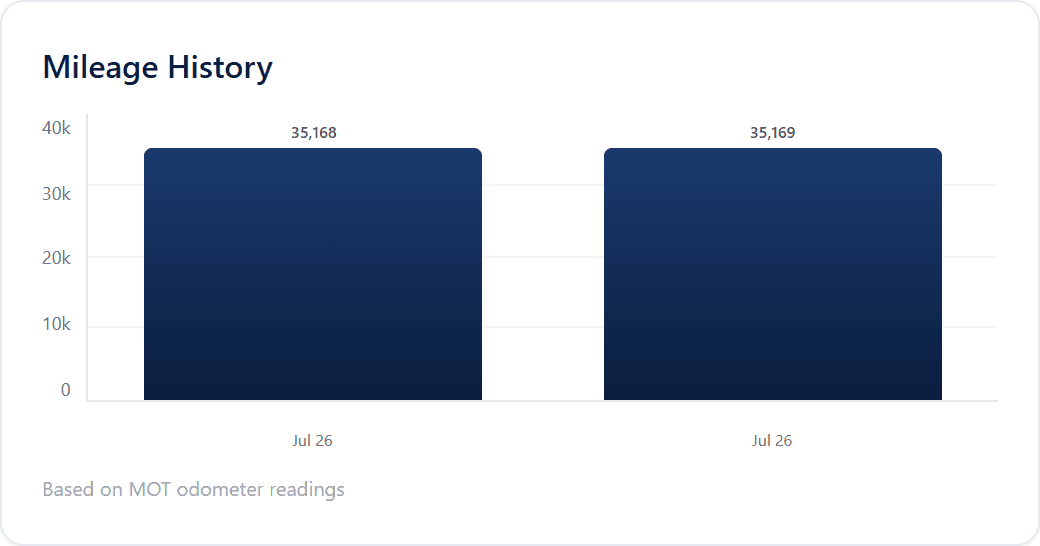
The DVSA records every MOT test carried out in Great Britain, and the record for a car is public. For each test it holds the date, the result, the odometer reading, the expiry date and every defect the tester logged, graded as advisory, minor, major or dangerous since May 2018. DealerPricing shows the full MOT history on the dashboard's History tab and on the free MOT check, newest test first, with the mileage readings drawn as a chart so a drop stands out.
Reading advisories as a prep estimate
Advisories do not fail the car, which is exactly why they matter to a buyer: they are the things that will need money soon. Tyres "close to the legal limit", brake pads "wearing thin", "slight play in nearside front suspension" and "corrosion to underside" are each a line on the prep invoice. Before bidding at auction or agreeing a part-exchange, list the advisories from the last two tests and cost them. Two tyres, a set of pads and a service on a family hatchback is £400 to £600 before the car turns a wheel on the forecourt, and that comes straight off the trade offer.
Failures are more revealing than advisories. A car that failed on a dangerous tyre and passed the retest a week later was driven on that tyre until it was forced off the road. A pattern of fail, retest, fail over several years describes an owner who fixed the minimum. Those cars need a deeper inspection than the advisories alone suggest.
Spotting a clocked car from the mileage readings
Because the odometer reading is recorded at every test, the history gives an annual mileage profile for the whole life of the car. Read it from oldest to newest. The reading should rise every year by a plausible amount; the UK average is roughly 7,400 miles. Two patterns are warning signs. A reading that is lower than the one before means the odometer was wound back or the tester mistyped it, and either way needs explaining. A car that covered 15,000 miles a year for five years and then 1,500 in the sixth was probably clocked just before sale, or has been sitting after a major fault.
DealerPricing plots the readings so the shape is obvious, and the vehicle history check compares every reading automatically and raises a mileage discrepancy alert if any reading goes backwards. The glossary entry on mileage discrepancy explains what the alert covers.
Using MOT expiry in the valuation
MOT expiry is a cost item. A car with two months left needs a test before retail, and an honest test on a car with existing advisories usually generates repair work. Factor a test and the likely repairs into the prep figure. Conversely, a fresh 12-month MOT with no advisories supports a Trade Clean bid, because the car has just been inspected by someone with no interest in the sale.
What MOT history cannot tell you
The MOT record shows condition on the day of each test and nothing else. It does not show accident repairs, insurance write-offs, outstanding finance, theft records, plate changes or previous keepers, because none of those are DVSA data. A Cat S car that was repaired well can have a spotless MOT history. That is why the free MOT check and the £2.50 history check are two halves of one process: the MOT history tells you what the car needs, and the provenance check tells you whether it is safe to buy at all. The advisories guide and the mileage history guide cover both halves step by step.
Cars with no MOT history
A car under three years old has no tests yet, so the mileage history starts at its first MOT. For those cars the mileage evidence comes from the service history and, for a part-exchange, the odometer against the customer's own account of use. Cars registered in Northern Ireland or imported later in life will also have gaps, and an import marker on the history check explains a short record.
A worked example
A 2016 Vauxhall Astra 1.4T at 78,000 miles comes up at auction. The MOT history shows a pass every year with readings of 9,800, 21,500, 33,200, 46,900, 58,100, 66,400 and 78,000, a steady 11,000 to 13,000 a year with no drops. The last test carries two advisories: front tyres close to the limit and a slight oil leak from the rocker cover. The previous test advised the same oil leak, so it has not been fixed in a year. Prep is costed at £280 for tyres and £150 for the leak, and the bid is set at Trade Average less £430. The history check is clear. The car is bought at a price that leaves the target margin after prep, and the tyres and the leak are done before it is photographed.
Frequently asked questions
Can I check a car's MOT history for free?
Yes. Enter the registration into the DealerPricing free MOT check to see every test since 2005 with the result, mileage, expiry date and all advisories and failures. No account, email or payment is needed. Dealer accounts see the same data on the dashboard with the mileage readings plotted as a chart.
How do I tell if a car has been clocked from its MOT history?
Read the mileage recorded at each test from oldest to newest. A reading that is lower than the previous one is a discrepancy and needs an explanation. A car whose annual mileage collapses in the year before sale is also suspect. A DealerPricing history check compares every reading automatically and raises a mileage discrepancy alert.
Do MOT advisories affect a car's value?
Yes, because each advisory is work that will be needed soon. Dealers cost the advisories as preparation and deduct them from the trade offer. Tyres, brakes and suspension advisories on a family car typically add £300 to £600 of prep, and a corrosion advisory on the structure can make a car unsaleable at retail.
Does the MOT history show accidents or write-offs?
No. The MOT record only shows the condition of the car on the day of each test. Insurance write-off records, accident damage, outstanding finance and theft markers come from private registers and are covered by a vehicle history check, which DealerPricing runs for £2.50 for subscribers or £3.99 one-off.