Used car buying checklist: the checks to run before you pay
A UK used car buying checklist in order: free MOT and tax check, £3.99 history check, V5C and VIN match, service history, test drive and paying safely.
Buying a used car safely comes down to a short list of checks in the right order: a free MOT and tax check on the registration before you travel, a £3.99 history check before you pay a deposit, the V5C and VIN matched against the car, the service history verified, and a test drive. It takes minutes, costs almost nothing, and catches the problems that cost thousands.
Key takeaways
- Do the free checks before you travel and the paid check before you pay anything.
- The V5C, the VIN on the car and the seller's ID must all agree.
- Finance owing, a stolen record or an undisclosed write-off are reasons to walk away, not negotiate.
- Advisories on the MOT are your negotiating list.
- Pay in a traceable way and get a receipt with the registration, mileage and price.
1. Run the free MOT and tax check on the registration
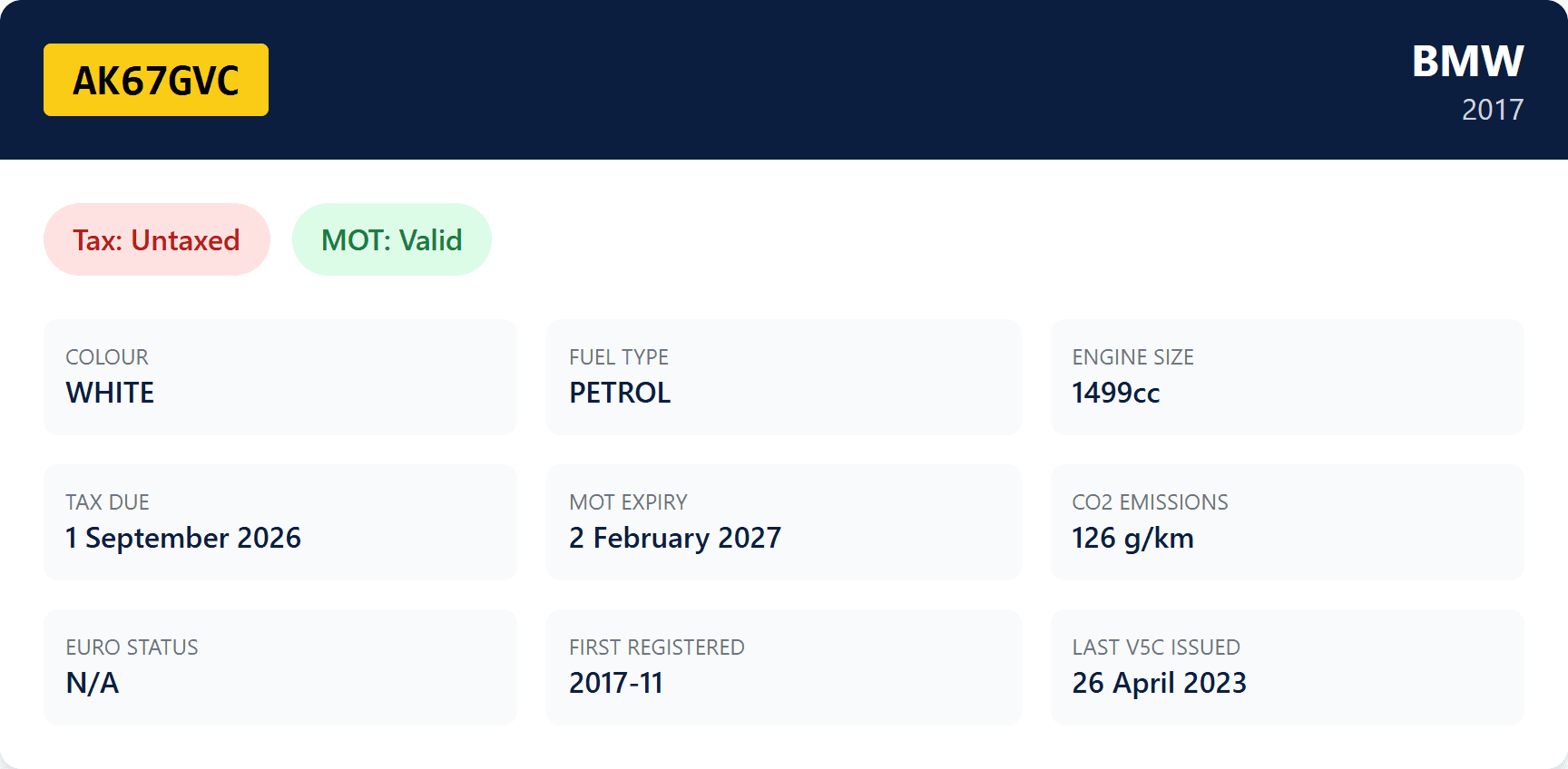
Before you go anywhere, put the registration from the advert into the free vehicle check. In seconds you get every MOT test since 2005 with mileage and advisories, the MOT expiry date, the tax status and the DVLA's record of the make, colour, fuel and engine size. Check three things: that the DVLA details match the advert, that the mileage readings rise steadily with no drops, and that the advisories on the last test are things you are prepared to pay for. If the advert says 40,000 miles and the last MOT recorded 52,000, save the journey.
2. Run a vehicle history check before you pay a deposit
The free check cannot see finance, theft or insurance write-offs, because those are held on private registers. A vehicle history check costs £3.99 with no account and searches all of them: stolen markers on the Police National Computer and MIAFTR, outstanding finance with the lender named, write-off category A, B, S or N, mileage consistency, plate and colour changes, and import, export and scrappage markers. Do it before any money changes hands. If finance shows, the car belongs to the lender until it is settled. If it is a Cat A or B write-off, walk away. If it is Cat S or N and the seller did not say so, walk away from the seller as well as the car.
3. Match the V5C, the VIN and the seller
Ask to see the V5C logbook. The name and address should match the seller and the address you are standing at; a private seller who "is selling it for a friend" or meets you in a car park is a warning sign. Compare the VIN on the V5C with the one visible through the windscreen and the one stamped on the chassis or a door pillar plate. All three must match each other and the VIN on your history report. Check the number of former keepers on the V5C against what the seller told you. The V5C glossary entry explains what each section means and what a missing or recently issued V5C can indicate.
4. Verify the service history
"Full service history" should mean a stamp or digital record at every manufacturer interval. Look at the dates and mileages, not just the number of stamps; a car serviced three times in six years does not have a full history. For cars serviced at franchised dealers, most manufacturers hold a digital record that a dealer can pull up; ask the seller to show it or ask a dealer to check. Independent garage work should be backed by invoices. A cambelt or major service that is due is a real cost and should come off the price. The service history glossary entry explains what counts.
5. Inspect the car in daylight
Look along each panel for ripples, mismatched paint or overspray on rubber seals, which suggest accident repair. Check the tyres for wear across the tread and for matching brands and dates. Open and close every door, the bonnet and the boot. Check that the mileage on the odometer is at or above the last MOT reading. Look under the oil filler cap for a creamy residue and under the car for leaks. Turn every switch on. Take the MOT advisory list with you and look at each item it mentions.
6. Test drive it properly
Start the engine from cold if you can; a warm engine hides starting problems and smoke. Drive it on a mix of roads for at least twenty minutes. Listen for knocks over bumps, feel for pulling under braking, check the clutch bites in the right place and every gear engages cleanly. Watch the temperature gauge and the warning lights. Try the air conditioning, the electric windows and the parking sensors. If the seller will not let you drive it, or insists on driving, do not buy it.
7. Agree the price with evidence
Use the MOT advisories, the service gaps and anything the inspection found as your list. A private seller's asking price is a starting point; a dealer's price includes preparation and usually a warranty, so the negotiation is about what is included. If you want to know what similar cars are selling for, the same live market data dealers use is behind the used car valuation page.
8. Pay safely and get the paperwork
Pay by bank transfer or card rather than cash, so there is a record. Get a written receipt showing the registration, VIN, mileage, price, date and the seller's name and address, signed by both of you. Complete the new keeper section of the V5C with the seller, or do it online together, and keep the green new keeper slip. Tax the car in your name before you drive it away, because tax does not transfer. Check your insurance covers you from the moment you take the keys.
Buying from a dealer versus privately
A dealer sale comes with consumer rights, usually a warranty and often a history check already done; ask to see the report, and if they cannot show one, run your own for £3.99. A private sale is usually cheaper but you have far fewer rights if something is wrong, so every check on this list matters more. Either way, the two checks that catch the expensive problems are the free MOT check before you travel and the history check before you pay.
Frequently asked questions
What is the most important check when buying a used car?
The vehicle history check, because it finds the problems that cannot be seen on the car: outstanding finance, a stolen record and an insurance write-off. A car with finance owing can be recovered by the lender from you even after you paid the seller. The check costs £3.99 on DealerPricing with no account.
What documents should I check when buying a used car?
The V5C logbook in the seller's name at the address you are at, the current MOT certificate or the online MOT record, the service history with dates and mileages, and any invoices for recent work. Match the VIN on the V5C with the VIN on the car and on your history report.
How do I check a used car's mileage is genuine?
Compare the odometer with the mileage recorded at each MOT test, which the free MOT check lists from 2005 onwards. The readings should rise steadily. A reading that drops, or a year where the mileage barely moved before sale, needs an explanation. A history check compares every reading automatically and raises a mileage discrepancy alert.
Can I drive a used car home after buying it?
Only if it has a valid MOT, is taxed in your name and you are insured to drive it. Tax does not transfer between keepers, so tax it online using the reference on the V5C before you leave. If the MOT has expired, the car can only be driven to a pre-booked test.