Vehicle history checks
What is a stolen-recovered car, and is it safe to buy?
Updated 3 October 2026 · 2 min read · by DealerPricing
A stolen-recovered car was reported stolen and later found. If the insurer had already paid the owner, the theft is recorded on the insurers’ register and stays on the car’s history, and the insurer usually sells the car on. It can be bought legally, but check its identity, any damage and the paperwork first.
Step by step
Check both stolen records
A history check reads the police stolen-vehicle marker and the insurers’ theft records. The police marker must be clear: if it still shows the car as stolen, it has not been recovered as far as the police are concerned, so do not buy it and report it. An insurer theft record on its own means the insurer paid out at some point.
Stolen car check →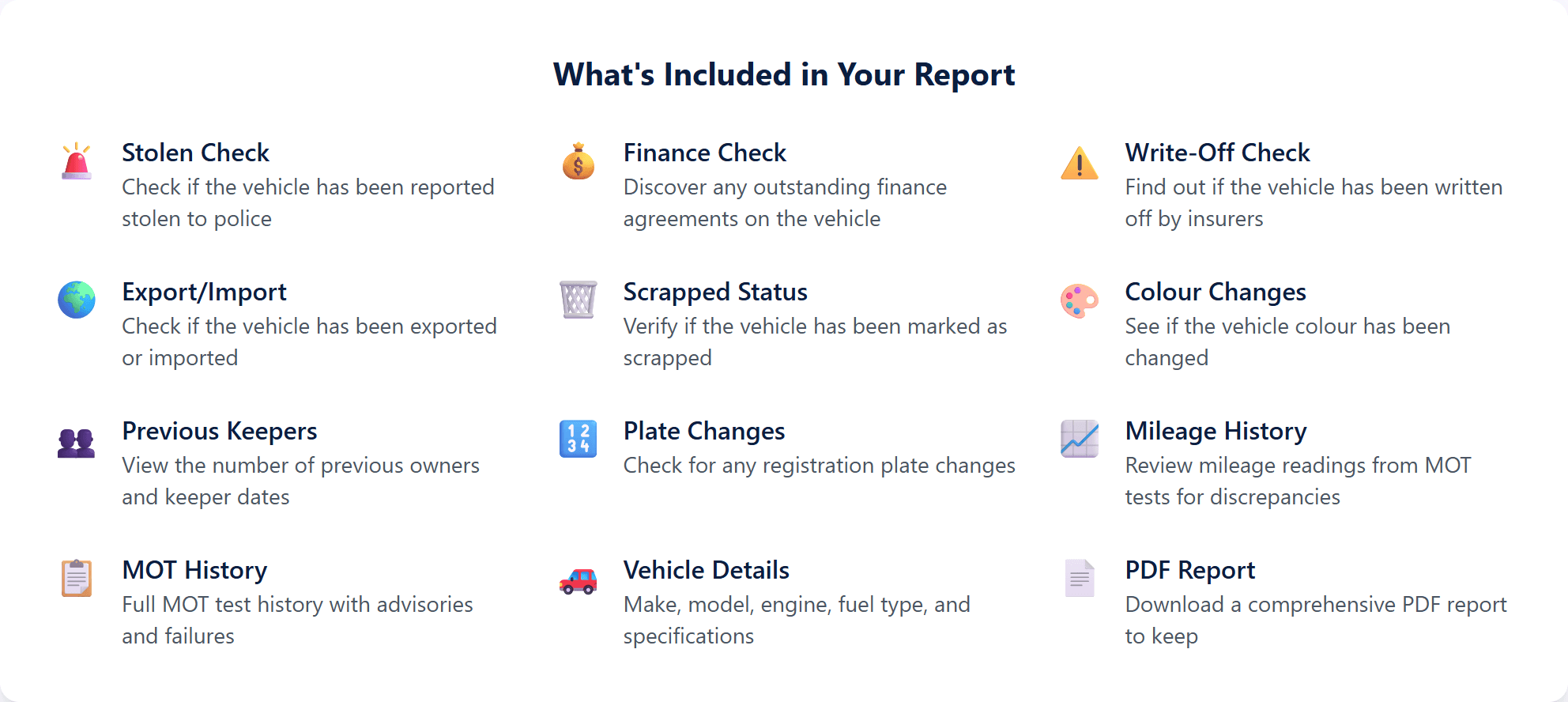
What a DealerPricing history report covers: stolen, finance, write-off, export/import, scrapped, colour changes, keepers, plate changes, mileage and MOT history Confirm the car’s identity
Stolen cars are sometimes given a false identity. Match the VIN on the car (windscreen, door pillar and under the bonnet) with the V5C and the history report, and make sure the make, model, colour and engine are exactly what the record says.
Check for damage or a write-off category
Recovered cars are often damaged. If the insurer judged the damage a total loss, the car will also carry a write-off category such as Cat S or Cat N, which changes what you should check and what it is worth.
Write-off check →Ask for the paperwork trail
The seller should be able to show how they came to own the car, for example a receipt from the insurer’s salvage sale and a V5C in their name. A seller who cannot explain the car’s journey since the theft is a reason to walk away.
Price it accordingly
A theft record stays on the car’s history, and some insurers ask about it, so a stolen-recovered car is usually worth less than the same car without one. Value a clean equivalent and negotiate down.
Ready to try it?
£2.50 for DealerPricing subscribers. Report stored for 6 months with a PDF.
Run a vehicle history check — £3.99 →Frequently asked questions
Is it legal to buy a stolen-recovered car?
Yes, as long as the car really has been recovered and the seller has the right to sell it, for example because they bought it from the insurer. If the police stolen marker is still showing, the car has not been recovered and buying it means you would not own it.
Why does the theft still show after the car was recovered?
Once an insurer pays out for a stolen car, the theft is recorded on the insurers’ register, MIAFTR, as part of the car’s history. Recovering the car does not erase that history, which is why history checks keep showing it.
What if a car was stolen and found before the insurer paid out?
If the car was recovered quickly, the claim was not paid and it was not damaged enough to be categorised, the theft is usually removed and will not show on a history check.
Is a stolen-recovered car the same as a write-off?
Not necessarily. A theft record means the insurer paid out for a theft. A write-off category (A, B, S or N) means the damage was judged a total loss. A recovered car can have one, the other or both, and a history check shows them separately.
Related guides
Terms explained
- Vehicle provenanceVehicle provenance is the verified history of a UK vehicle's ownership, status and incidents — covering stolen markers, finance, write-offs, mileage, plate changes, and keeper history.
- V5C logbookThe V5C is the official UK vehicle registration document issued by DVLA, showing the registered keeper, vehicle technical details and ownership history.